

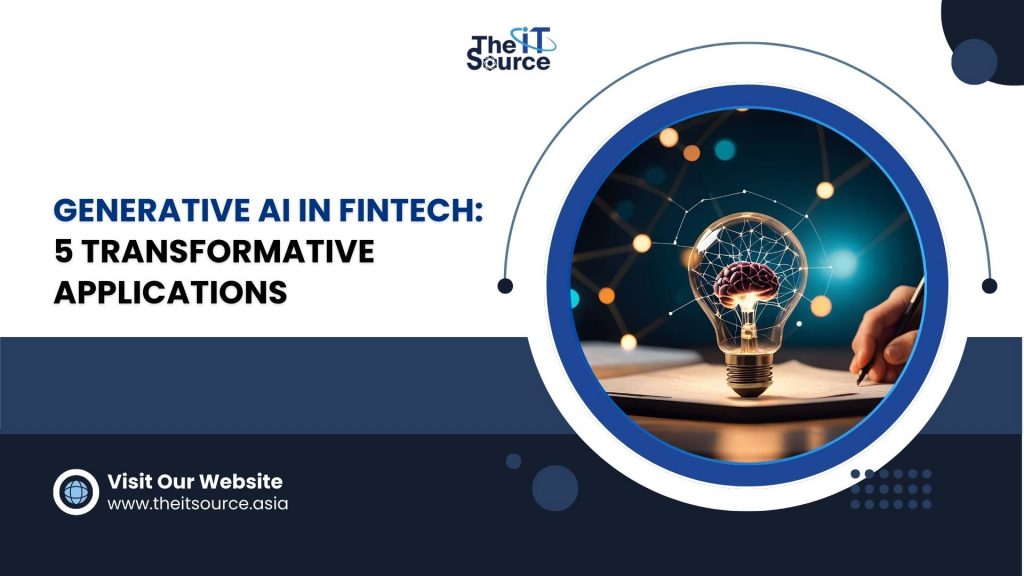
Generative AI in Fintech: 5 Applications Transforming 2026
In the fintech world, especially in demanding markets such as Europe and Japan, a manager’s role often feels like walking a high-stakes tightrope. On one side lies the relentless flow of financial data and the constant risk of sophisticated fraud. On the other side stands an increasingly complex web of regulations, such as the GDPR and the EU AI Act, which require full transparency and accountability.
Balancing security, compliance, and growth without letting operational costs spiral can feel like a daily battle.
Generative AI in fintech is changing that equation.
This technology is no longer theoretical; it has become a trusted partner that empowers financial teams to detect fraud before breaches occur, analyze complex regulatory updates in real time, and deliver personalized customer experiences at scale. Most importantly, it achieves all this while keeping humans in control and maintaining data transparency, which strengthens long-term trust.
This article examines five transformative applications that are revolutionizing how fintech organizations secure assets, ensure compliance, and achieve a sustainable competitive advantage.
What is generative AI in fintech?
Generative AI refers to advanced artificial intelligence systems capable of creating new data, models, or insights rather than simply analyzing existing ones. These models, often referred to as foundation models or large language models (LLMs), learn patterns from vast financial datasets and utilize that knowledge to generate realistic outputs, including text, code, visualizations, and predictive financial models.
In the fintech industry, this capability represents a major shift from automation to adaptation. Traditional AI might flag a transaction as potentially fraudulent because it matches patterns found in historical data. Generative AI takes it a step further by simulating thousands of potential fraud scenarios, enabling systems to anticipate risks that have not yet materialized. It can also analyze a lengthy regulatory report and summarize the most critical compliance risks for a specific business unit, giving executives the clarity they need to make timely and informed decisions.
This evolution transforms financial operations from reactive monitoring to proactive intelligence. By providing context-aware analysis, generative AI enhances risk forecasting, portfolio management, and hyper-personalized financial services, thereby improving both performance and customer trust.
At the same time, the growing adoption of generative AI brings greater responsibility. Global regulations such as the EU AI Act and GDPR emphasize that every AI-driven decision must be transparent, traceable, and privacy-preserving. For FinTech firms, compliance is no longer a technical requirement but a foundation for sustainable growth and credibility in global markets.
Organizations that recognize this are turning to The IT Source (The IT Source) as a trusted partner to implement secure, compliant, and enterprise-ready generative AI solutions. With experThe IT Sourcee in on-premise AI deployment, secure data architecture, and Agentic AI development, The IT Source helps financial institutions integrate innovation responsibly, ensuring that every AI system aligns with governance standards and business objectives.
5 transformative applications of generative AI in fintech
The impact of generative AI in fintech extends far beyond automation. It is reshaping how financial institutions detect risks, manage data, and deliver personalized experiences while meeting the world’s strictest regulatory standards.
From fraud detection and compliance monitoring to asset management and customer intelligence, generative AI is now embedded at the core of digital finance. The following five applications showcase how leading organizations are leveraging it to achieve secure, measurable, and sustainable transformation — turning innovation into tangible business value.
1. Enhancing security and real-time fraud detection
Security is the non-negotiable foundation of financial trust. As transaction volumes grow and cyber threats evolve, traditional rule-based systems can no longer detect the complex and dynamic nature of modern fraud. Generative AI introduces an adaptive layer of defense that continuously learns from real-time datasets. It identifies subtle anomalies that reveal coordinated fraud or money-laundering (AML) activities across networks and payment ecosystems.
Unlike static models, this new generation of AI anticipates emerging attack methods by generating thousands of simulated fraud typologies. It strengthens existing cybersecurity frameworks by analyzing user behavior, device metadata, and transaction context simultaneously, identifying suspicious activities with high precision while minimizing false positives that affect genuine customers.
Through secure, on-premise AI deployments and explainable anomaly detection aligned with the EU AI Act, financial institutions can achieve faster detection and stronger regulatory assurance. According to IBM’s 2024 Cost of a Data Breach Report, organizations using AI-driven threat detection reduce incident response times by over 40 percent and save millions annually through loss prevention and improved compliance.
2. Improving Data Quality and Accuracy
In the financial services industry, accuracy is not optional. A single error in transaction data or a misclassified risk variable can result in regulatory penalties and a loss of client trust. Generative AI in fintech addresses these challenges by improving the quality, integrity, and reliability of financial data.
Traditional validation systems struggle to manage the growing complexity of today’s data. Generative AI learns from historical and real-time datasets to identify inconsistencies, fill missing values, and generate synthetic data that mirrors real-world staThe IT Sourcetics without exposing personal information. This capability enables institutions to train AI models in full compliance with the GDPR and other data privacy frameworks, while preserving analytical accuracy.
The technology also enhances the ETL (extract, transform, load) process by predicting data quality issues and automatically generating human-readable audit trails. As highlighted by McKinsey, firms that invest in automated data-quality management experience a 25% increase in model performance and a reduction in time-to-insight.
According to the OECD AI Principles, maintaining transparent and high-quality data pipelines is essential for trustworthy AI. By leveraging generative AI responsibly, FinTech organizations can transform fragmented data into a secure and compliant foundation for innovation and long-term growth.
3. Strengthening compliance and regulatory governance
Regulatory compliance is one of the largest operational costs in banking, often requiring thousands of employees to manually review reports, transactions, and evolving rules. Generative AI in fintech is transforming this process by introducing intelligent automation that increases accuracy, transparency, and speed.
AI models can be trained on comprehensive regulatory frameworks, such as MiFID II and Basel III, as well as internal company policies and historical audit data. Once deployed, these systems can analyze millions of transactions and communications in real time to detect potential compliance breaches before they occur. For example, an AI system can monitor internal messages to identify signs of insider trading or verify whether financial advice is suitable for a client’s documented risk profile.
A central principle of the EU AI Act and related European Commission guidelines is the concept of ‘glass-box’ transparency, particularly for high-risk AI systems. Financial institutions must be able to explain how and why an AI made a decision, such as a loan rejection or investment classification. Modern generative models now integrate explainable AI (XAI) capabilities to meet these requirements, providing clear and auditable decision paths.
For global institutions, data residency and sovereignty are equally critical. Cloud-based AI systems can inadvertently transfer sensitive data across borders, creating risks under frameworks such as the GDPR. Deploying AI within secure, on-premise environments ensures that data remains within jurisdictional boundaries and meets local compliance obligations. By adopting this approach, financial organizations can enhance both regulatory assurance and operational efficiency while maintaining trust and transparency with clients and regulators.
4. Revolutionizing Market Analysis and Asset Management
Financial markets move quickly, and data grows more complex every day. Generative AI in fintech helps asset managers and financial institutions turn this complexity into timely and actionable insight.
Generative AI processes both structured and unstructured information. It can read market reports, track social sentiment, follow geopolitical developments, and absorb macroeconomic indicators simultaneously. By revealing correlations that are easy to overlook, it generates predictive signals that enhance portfolio construction and trade selection. For example, an AI system can detect an early supply chain disruption, connect it to regional sentiment changes, and estimate its likely impact on commodity prices before the move becomes apparent in public data.
The capability does not stop at analysis. Generative AI supports portfolio stress testing through the generation of scenarios. Teams can simulate thousands of economic paths, evaluate drawdown risks, and assess the resilience of allocation strategies under different market conditions. Results are explained in clear language, allowing investment committees to review the reasoning behind each recommendation.
When combined with strong governance and clear oversight, this approach enhances decision-making speed, reduces blind spots, and facilitates audit-ready documentation. The outcome is a more adaptive asset management process that strikes a balance between performance, transparency, and control.
5. Human–AI Collaboration in Financial Operations
The idea that AI will replace human roles in finance oversimplifies reality. In practice, Generative AI in fintech is strengthening human experThe IT Sourcee rather than displacing it. The most effective model is one of collaboration, where AI acts as a co-pilot that augments professional judgment and removes repetitive tasks.
This collaboration is already transforming financial operations. In customer service, a customer service AI agent can manage up to 80 percent of routine inquiries at any time of day. When a complex request arises, the AI seamlessly escalates the case to a human representative and provides a concise summary of the issue and the customer’s sentiment, ensuring a smooth handover and consistent service quality.
Inside financial organizations, a staff support AI agent can prepare preliminary compliance reports, summarize extensive documentation, or generate simple SQL queries on demand. These capabilities allow human analysts and advisors to concentrate on strategic decision-making, client relationships, and ethical oversight — areas where human insight remains irreplaceable.
Human–AI collaboration marks a shift from automation to empowerment, creating workplaces that are faster, more intelligent, and more human-centered.
Emerging Opportunities: Beyond Automation
The applications discussed above focus on optimizing existing financial operations, but the true potential of generative AI in fintech lies in creating entirely new service models. The industry is moving beyond automation into an era of proactive, personalized, and adaptive finance.
Next-generation AI agents can analyze individual spending patterns, investment goals, and risk tolerance to provide real-time, data-driven financial planning. The same technology can transform loan processing by shifting from static credit scoring to dynamic risk assessments based on a comprehensive, real-time understanding of each applicant’s financial profile.
This evolution leads to the emergence of agentic AI, which represents the convergence of generative and predictive intelligence. Unlike traditional systems that simply follow instructions, an agentic AI can define its own objectives, learn from outcomes, and continuously improve its reasoning models. This capability paves the way for fully autonomous systems in areas such as risk management, portfolio optimization, and algorithmic trading.
The future of fintech is defined not by automation but by adaptation. Self-improving systems that combine decision-making autonomy with transparency and accountability are becoming the foundation of intelligent financial ecosystems — a vision that aligns closely with the AI innovation frameworks developed at The IT Source (The IT Source).
Risks And Ethical Considerations
No discussion of AI for financial services is complete without a transparent look at the significant risks. The power of these models is matched by their potential pitfalls. Key risks include:
- Inaccuracy and bias: If an AI is trained on biased historical data (e.g., data that reflects historical lending discrimination), it will learn and amplify those biases, leading to unfair, discriminatory, and illegal outcomes.
- Lack of explainability: The “black box” problem. If a bank cannot explain why its AI model denied a customer credit, it violates regulatory principles (like the right to explanation) and erodes trust.
- Data memorization and privacy: Models can sometimes “memorize” and repeat sensitive, private data from their training sets, potentially leading to a massive data breach.
- Copyright and IP: There are complex, unresolved legal questions regarding the copyright of AI-generated code or analysis, as well as the data it was trained on.
Navigating these challenges requires a robust “Responsible AI” framework, as detailed in reports by the OECD and PwC. Best practices include rigorous model validation, adversarial testing for bias, continuous human oversight, and a deep commitment to ethical AI principles.
At The IT Source, we develop systems tailored to the stringent regulatory environments of the EU and Japan. This means prioritizing secure, explainable, and compliant AI from day one, ensuring our clients can innovate with confidence and maintain the absolute trust of their customers.

Conclusion: Building Trustworthy FinTech with Generative AI
Generative AI in fintech is more than a technological breakthrough; it is a strategic enabler of security, compliance, and intelligence across the financial ecosystem. It provides a clear path to greater operational efficiency, enhanced decision-making, and a new era of human–AI collaboration.
Yet innovation in finance can only be sustainable when it is built on trust, ethics, and rigorous compliance. The true value of AI does not lie in its novelty but in how it is implemented responsibly. Secure architecture, transparent algorithms, and accountable governance are what turn technology into a long-term business advantage.
At The IT Source, we help financial institutions achieve this balance. Our experThe IT Sourcee in AI-powered automation and secure offshore development enables organizations to innovate confidently while maintaining full alignment with international regulatory standards. We design systems that perform, protect, and comply — ensuring technology serves both progress and principle.
Ready to shape the future of finance responsibly? Contact The IT Source to explore secure, compliant AI solutions that deliver measurable and lasting impact.