

Agents for Business Intelligence: Drive Smarter Insights and Decisions
Are your outdated business intelligence (BI) tools slowing you down? In today’s fast-paced market, relying on slow, traditional BI systems means missing out on critical data insights. It’s time to upgrade and make smarter, faster decisions with AI-powered business intelligence.
Business intelligence using AI agents is the solution. By harnessing the power of AI, these agents process large datasets in real time, uncovering insights and enabling faster, more accurate decisions.
For companies in Europe and Japan, where efficiency and compliance are key, AI-driven business intelligence solutions enable them to make decisions quickly, meet regulatory standards, and achieve a clear return on investment.
The IT Source partners with businesses to implement AI-powered BI systems that integrate seamlessly with your existing infrastructure, scale with your growth, and deliver measurable results from the start.
What is business intelligence using AI?
Business Intelligence (BI) has long been essential for analyzing data to make informed decisions. However, traditional BI systems often rely on static dashboards and manual data processing, which make it difficult to keep up with fast-moving data. As the pace of business accelerates, these outdated tools cannot provide the real-time insights businesses need to stay ahead.
Business intelligence using AI shifts BI from a retrospective tool to a predictive and prescriptive engine. By integrating AI agents into BI platforms, companies can:
-
Automate data cleansing, enrichment, and anomaly detection.
-
Use machine learning to forecast outcomes and suggest actionable steps.
-
Enable decision-makers to query data naturally through natural language processing (NLP), without technical expertise.
-
Continuously adapt to new data for enhanced accuracy and relevance.
According to Gartner’s Magic Quadrant for Analytics and Business Intelligence Platforms, AI and advanced analytics are now central to modern BI tools. These capabilities enable organizations to deliver insights faster, react to market shifts more efficiently, and make data-driven decisions in hours, not weeks. AI-driven BI is no longer just an enhancement but is becoming a standard business capability.
Traditional BI vs AI-Powered BI
| Feature / Capability | Traditional BI | AI-Powered BI with AI Agents |
| Data Processing | Manual ETL, periodic updates | Automated, continuous ingestion and cleansing |
| Insights | Descriptive (what happened) | Predictive and Prescriptive (what will happen and what to do) |
| User Interaction | Pre-built dashboards, limited flexibility | Conversational AI queries, dynamic visualizations |
| Adaptability | Static models require manual tuning | Self-learning models that adapt to changing data |
| Decision speed | Hours to days | Real-time, event-triggered |
| Scalability | Limited by human capacity | Handles high-volume, high-velocity data at scale |
For EU and Japanese markets, this adaptability is critical. AI agents can integrate compliance verification into every analysis, ensuring that rapid decisions also meet stringent regulatory standards like GDPR.
Benefits and real-world applications of business intelligence using AI
The integration of AI-powered BI offers much more than operational efficiency. It directly impacts competitive positioning, market adaptability, and long-term profitability by providing actionable insights that allow businesses to make better, faster decisions.
1. Faster, more accurate decision-making
In industries such as finance and logistics, the speed of decision-making is crucial to maintaining a competitive edge. AI agents can process and analyze vast amounts of data in real time, enabling businesses to identify risks and opportunities as they emerge. For example, AI-driven BI can detect unusual transaction patterns in real time, enabling compliance teams to prevent financial fraud and protect brand trust. In the logistics industry, AI can also optimize delivery routes in real time based on traffic and weather data, significantly improving on-time performance and reducing delivery costs.
2. Predictive and prescriptive insights
Traditional BI can only tell you what happened in the past. With AI-driven BI, companies can not only analyze historical data but also forecast future trends and recommend the best course of action. A McKinsey report highlights that businesses using predictive analytics experience 10–15% revenue growth and up to 20% increase in sales ROI (Shift Paradigm). For example, in the retail industry, AI can help companies predict demand, dynamically adjust pricing, and proactively manage stock to prevent overstock or stockouts.
3. Enhanced customer understanding
Today’s consumers expect highly personalized experiences. AI-powered BI consolidates customer data from various sources like websites, apps, and call centers. It then applies sentiment analysis to understand not just what customers do, but why they do it. IBM reports that businesses using AI-driven customer analytics can generate insights 3–5 times faster, allowing marketing teams to adjust campaigns in real-time and increase relevance.
4. Operational efficiency
AI doesn’t just speed up processes; it transforms them. By automating routine tasks such as data cleansing, anomaly detection, and report generation, AI frees up valuable human resources to focus on strategic work. For example, in logistics, AI-powered BI can analyze real-time data from multiple sources like traffic, weather, and demand forecasts. It then suggests the best delivery routes and schedules, leading to cost savings and improved operational efficiency.
5. Competitive advantage in regulated markets
For businesses in regulated markets like those in the EU and Japan, compliance is essential. AI-powered BI can automatically detect anomalies, integrate GDPR safeguards, and generate detailed audit logs, ensuring compliance and reducing the risk of costly fines. By automating compliance processes, businesses can reduce operational costs and build trust with partners and customers, giving them a strong edge in B2B markets.
Want to boost your decision-making speed and accuracy? Learn how AI agents can transform your business intelligence and gain a competitive edge. Contact us for a demo!
Detailed implementation framework for AI-powered business intelligence
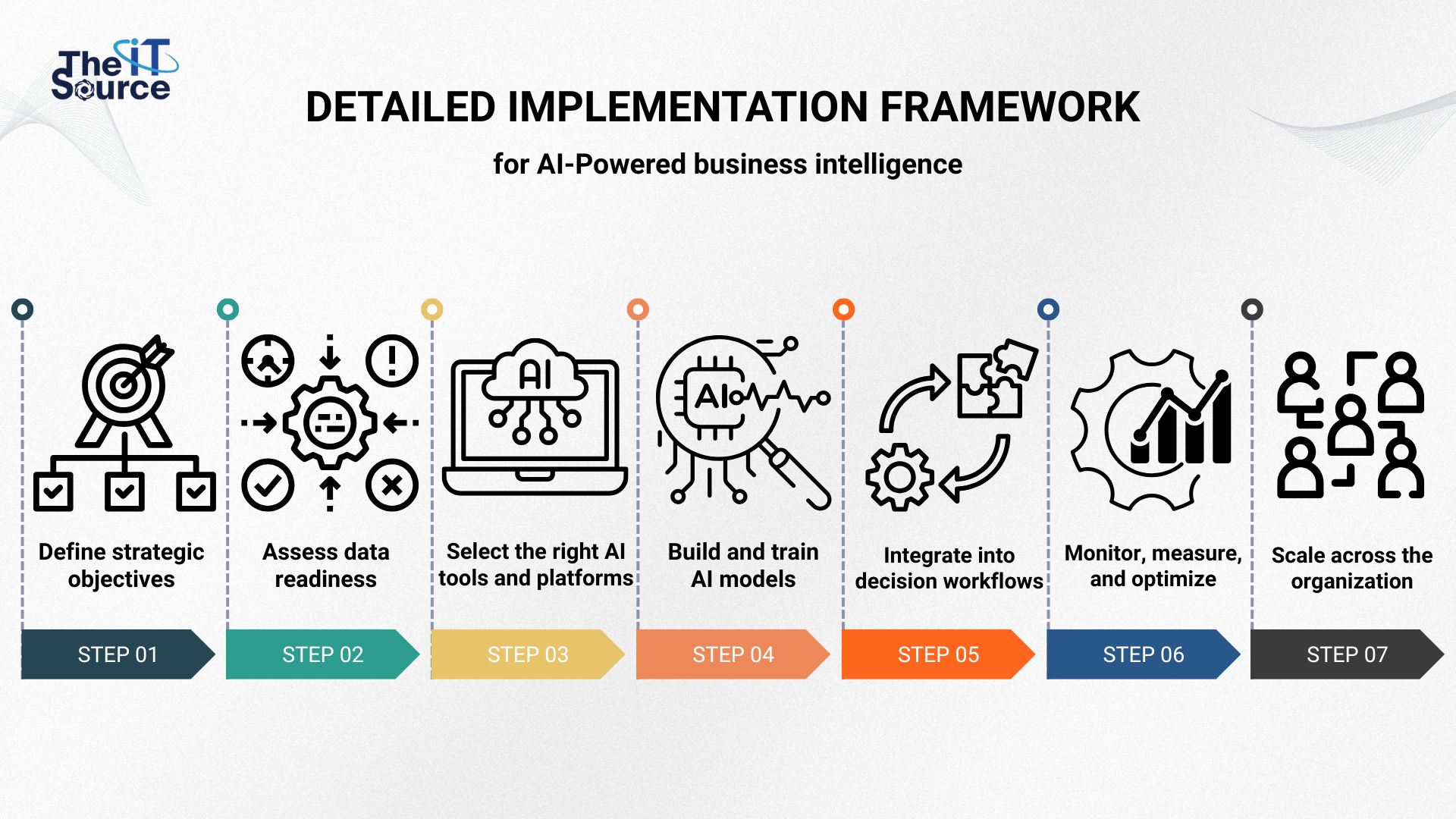
Rolling out Business intelligence using AI is a strategic initiative that demands a structured approach. This 7-step framework ensures effective adoption:
- Define strategic objectives: Clearly define whether your goal is to reduce costs, increase revenue, or enhance compliance. A focused objective shapes your AI implementation and ensures alignment with business priorities.
- Assess data readiness: Ensure your data is clean, accessible, and ready for AI processing. In regulated markets, ensure compliance with privacy standards like GDPR before moving forward.
- Select the right AI tools and platforms: Select platforms that offer automated data prep, machine learning capabilities, and natural language processing (NLP) to help your team use AI-driven insights without the need for deep technical knowledge.
- Build and train AI models: Use historical and real-time data to build AI models that reflect your business needs. Incorporate industry-specific rules to ensure AI outputs match your operational reality.
- Integrate into decision workflows: Ensure that AI insights are accessible to decision-makers in real-time via ERP, CRM, or custom dashboards, streamlining the decision-making process.
- Monitor, measure, and optimize: Track the effectiveness of your AI system using key metrics such as time-to-insight, forecast accuracy, and impact on ROI. Regularly retrain models with new data to keep them relevant and accurate.
- Scale across the organization: Once AI solutions show proven value, expand their use across high-impact areas. Document best practices and share success stories to encourage broader adoption within your organization.
Next steps
The evolution from traditional BI to business intelligence using AI represents more than a shift in tools; it’s a redefinition of decision-making itself. By deploying AI intelligent agents, companies in Europe and Japan can not only react faster but also anticipate change, navigate uncertainty, and execute with precision.
According to Forrester research, firms that use advanced insights to inform their business processes are 2.8x more likely to report double‑digit year‑over‑year growth. As AI models mature and regulations evolve, BI systems will become more autonomous, ethical, and deeply integrated into daily operations (Adobe for business)
The IT Source helps businesses in the EU and Japan build AI-powered BI systems that balance innovation with compliance.
Ready to make smarter, faster decisions with AI-powered business intelligence? Get in touch with us now and see how our solutions can boost your ROI today!