

AI trends 2026: 7 shifts redefining how businesses work
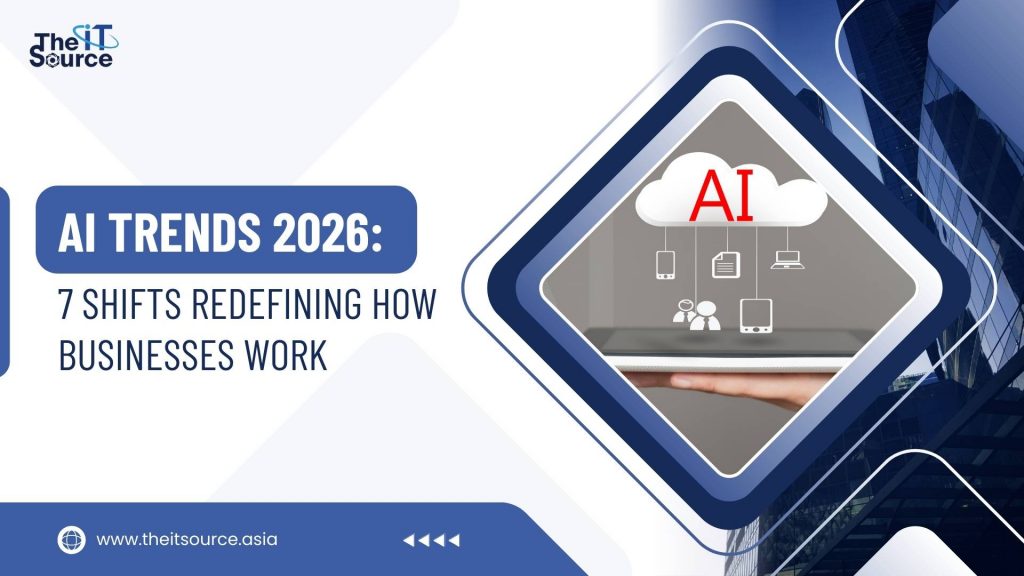
Artificial intelligence is entering a new phase. By 2026, AI will no longer be a supporting tool but a core driver of how businesses run, make decisions, and deliver value. Reports from organisations such as Gartner show that AI capabilities are being built directly into the systems companies use every day, reshaping operations at a speed most leaders did not expect.
This shift raises an essential question for businesses in Japan and Europe: Are we adapting fast enough? Many organisations already feel the pressure as customer expectations change, workflows become more automated, and regulations tighten. At The IT Source, we see this transition firsthand through projects involving AI automation and offshore development. These insights also reflect the direction discussed in our recent article on AI adoption for business growth.
The following sections break down seven AI trends shaping 2026 so you can understand what is coming and how your business can respond with clarity and confidence.
1. AI becomes a native layer in business software
A major shift heading into 2026 is the way AI is becoming a built-in layer within the software businesses use every day. Instead of functioning as optional add-ons, AI capabilities are now being designed directly into the core architecture of modern platforms. Many software providers are moving away from feature-based development and toward intelligent, AI-driven workflows.
This means familiar tools will soon behave very differently. CRMs may highlight high-value leads automatically. ERP systems may generate real-time forecasts without manual input. Collaboration platforms may summarise meetings and recommend action items as part of the natural workflow. AI becomes less visible as a separate feature and more present as the underpinning logic that shapes how work gets done.
For businesses, the impact goes beyond technology. Teams must learn how to evaluate AI-generated suggestions, understand when automation adds value, and effectively integrate these insights into their decision-making processes. The skill shift is moving from operating software to understanding how to collaborate with intelligent systems.
2. The emergence of AI-focused roles across the organization
As AI becomes embedded in business operations, the workforce is changing just as quickly. Across industries, new roles are emerging to manage, supervise, and optimize the use of AI within organizations. These roles are not limited to engineering teams; they are emerging in operations, HR, customer service, and strategy.
Reports from leadership advisory groups highlight a sharp rise in positions such as AI workflow leads, agent operations specialists, conversational designers, and prompt engineers. Each plays a role in helping businesses leverage AI capabilities to achieve consistent performance gains.
The shift signals something important: AI adoption is no longer a technical project. It is an organisational capability. To make AI effective, companies need people who understand how to shape prompts, monitor AI behaviour, validate outputs, and align automated workflows with business goals.
For many businesses in Japan and Europe, this creates a practical challenge. Internal teams often lack the time or expertise to take on these new responsibilities immediately. As a result, organisations are blending internal upskilling with external support models, including offshore development teams that can accelerate AI implementation while guiding knowledge transfer.
3. Automation evolves into AI-directed workflow orchestration
In 2026, business automation is moving beyond isolated task automation to intelligent orchestration powered by AI agents. Instead of simply executing predefined steps, modern AI systems can interpret context, make decisions, and coordinate actions across multiple systems and teams. This shift transforms automation from a tool that “helps” into a capability that actively manages workflows.
This evolution is often referred to as agentic AI, where autonomous agents handle connected processes rather than single repetitive tasks. Recent industry coverage highlights how AI agents are replacing static, rule-based automation tools and working across business functions to adapt in real-time and optimize outcomes.
For businesses, this means processes that once required manual handoffs, repeated interventions, or separate automation points can now be overseen by a single orchestrated flow. Tasks such as data routing, approval chains, reporting, and inter-departmental actions become coordinated by AI, freeing people to focus on decision-making and exception handling.
This transition calls for a new design approach to workflow automation. Instead of thinking in terms of discrete automation scripts, organisations must visualise end-to-end processes where AI interprets triggers, manages steps, and adjusts actions based on outcomes. Teams that adapt this mindset will gain faster execution, fewer bottlenecks, and stronger operational resilience.
4. The rise of shadow AI and unsupervised tool adoption
As AI tools become more accessible, many employees are beginning to use them independently, often without approval or visibility from the organisation. This behaviour, widely referred to as shadow AI, is rising quickly and has become a concern across multiple industries. According to MIT Sloan Management Review, shadow AI introduces risks because businesses cannot track which tools are being used, how data is processed, or whether outputs comply with internal standards and legal requirements.
The issue is not that employees want to bypass policies. In most cases, they are simply trying to work more efficiently. The real problem is the absence of oversight. When AI is used informally, companies face preventable vulnerabilities such as inconsistent output quality, inaccurate information, or potential violations of regulations like GDPR.
A more effective approach is to guide AI adoption rather than restrict it. Businesses can reduce shadow AI by establishing clear usage policies, defining approved tools, and introducing monitored environments where employees can use AI safely and productively.
5. AI governance becomes a strategic and regulatory priority
As AI becomes deeply embedded in business operations, governance is quickly moving from a technical consideration to a board-level responsibility. Global regulations are evolving, and organisations must demonstrate that their AI systems are transparent, traceable, and aligned with ethical and legal standards. According to a Reuters report on China’s expanding AI regulatory framework, more than 50 new AI-related standards are expected to shape global expectations for safety and accountability.
This trend underscores a broader shift. Businesses must ensure that their AI outputs can be audited, that data flows comply with privacy laws, and that automated decision-making is explainable when required. For companies operating in Japan or Europe, this becomes even more critical due to stringent data protection requirements and the upcoming operational demands of the EU AI Act.
Effective governance also requires cross-functional alignment. Legal teams must understand how AI is used, technical teams must document system behaviour, and business leaders must set clear boundaries for acceptable AI use. Without this structure, organisations risk reputational damage, regulatory scrutiny, and operational inconsistencies.

6. Conversational AI starts replacing traditional search interfaces
Another significant shift emerging in 2026 is the move from traditional search-and-click interfaces to conversational AI. Instead of navigating dashboards or typing complex queries, users increasingly rely on natural language interactions to retrieve information, generate insights, or trigger actions. According to an IBM report on the future of user interfaces, conversational systems are rapidly becoming the primary means by which employees and customers access knowledge and services.
This shift is driven by the speed and simplicity conversational AI provides. Employees no longer need to memorise menu paths or search through documentation. Customers can get answers without waiting in support queues. The interface becomes more intuitive, and the barrier to accessing information is dramatically reduced.
For businesses, the implication is clear. Systems that rely heavily on manual search or static workflows will feel increasingly outdated. Organisations must prepare to redesign knowledge systems, customer interactions, and internal support processes so they can respond fluidly through AI-driven dialogue.
7. Businesses shift toward operating models powered by AI agents
The final trend shaping 2026 is the move toward operating models built around AI agents rather than traditional tool-based workflows. These agents are capable of understanding context, initiating actions, coordinating with other systems, and completing multi-step tasks with minimal human intervention. A recent analysis by The Information highlights how agent-based architectures are gaining momentum as businesses look for automation that adapts rather than simply executes.
This shift represents a deeper transformation. AI is no longer just supporting work—it is participating in it. Agents manage processes that previously required multiple people, perform routine decision-making, and operate continuously in the background. Businesses adopting this model gain faster cycle times, fewer handoffs, and more consistent execution.
However, moving toward an agent-driven structure requires rethinking roles and workflows. Teams must determine which responsibilities are best suited for AI, where humans add the most value, and how both can work together effectively to achieve optimal results. Organisations that cling to tool-based processes risk slower adaptation and greater operational complexity.
What these shifts mean for your business
The acceleration of AI adoption means businesses can no longer treat AI as a side initiative. Each of the trends above signals a deeper transformation in how value is created, how teams operate, and how decisions are made. Leaders must now evaluate where their organisation stands and how prepared they are for an environment shaped by AI-native software, autonomous workflows, new skill requirements, and rising governance expectations.
A practical starting point is to ask three questions:
- Which of these shifts are already happening inside your organisation?
- Where are the gaps between current capabilities and future needs?
- Who is responsible for guiding your AI strategy and ensuring it aligns with business goals?
The answers often reveal a mixture of progress and uncertainty. Many teams have begun experimenting with AI, yet lack the structure to scale it safely. Others want to automate processes but face challenges such as legacy systems, skills shortages, or compliance concerns. These challenges are common across the companies we support, whether they operate in Japan, Europe, or Southeast Asia.
How The IT Source supports your AI adoption journey
Successfully adopting AI requires more than selecting the right technologies. It requires a clear strategy, disciplined execution, and the ability to integrate automation seamlessly into existing operations without causing disruption. Many businesses understand the potential of AI but struggle with practical questions. They want to know which workflows should be automated first, how to manage compliance, and where to find the technical expertise needed to implement AI safely.
The IT Source helps organisations move from intention to action. Our approach combines AI automation expertise with the operational structure necessary to deliver results that matter. Whether your business is modernising legacy systems, introducing AI agents to streamline complex processes, or building governance models that meet GDPR and upcoming AI regulations, we provide the guidance needed to progress with confidence.
Our support typically includes:
- AI-driven workflow design, enabling businesses to shift from task automation to coordinated end-to-end processes.
- Conversational AI solutions, improving how employees and customers access information.
- Governance and compliance practices ensure that AI usage is transparent and aligned with regulatory obligations.
- Offshore development teams, offering scalable engineering capacity along with bilingual communication for Japan and Europe.
Our goal is to help organisations automate in a meaningful way. This entails reducing operational friction, enhancing accuracy, and laying a foundation for long-term resilience. You can explore related perspectives in our article on AI and business performance, which discusses how companies can leverage AI to enhance their day-to-day operations.
If your business is preparing for the next stage of AI adoption, please contact us to discuss how we can collaborate on building a practical and compliant AI roadmap.