

AI Automation in 2026: 5 Trends Driving Business Scale
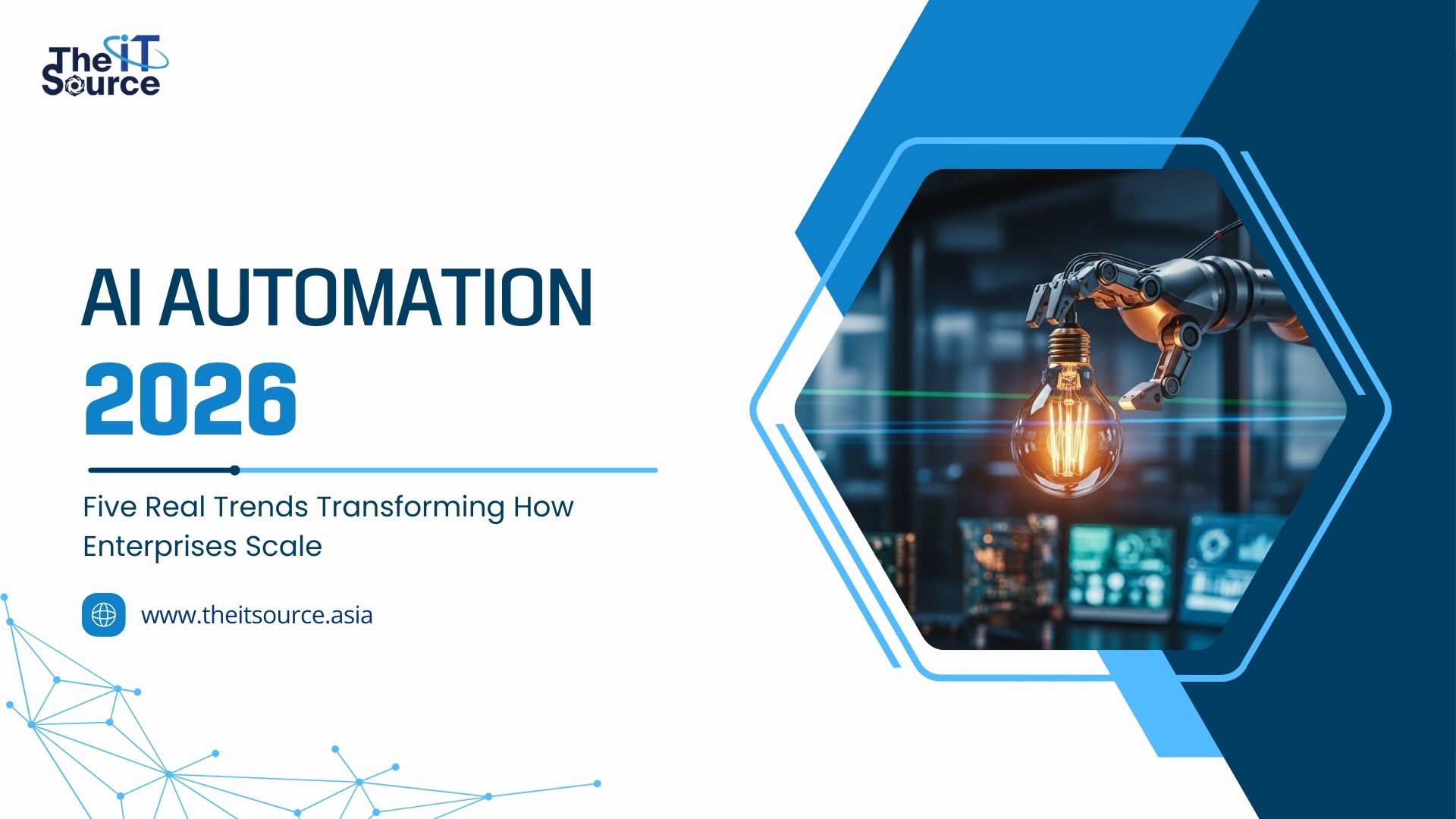
The age of experimental AI automation is over. In 2026, businesses are entering a new chapter: turning AI from isolated tools into core infrastructure for productivity and resilience. According to Gartner’s AI Hype Cycle 2025, automation driven by AI agents, hyperautomation, and governance frameworks is moving into mainstream adoption. Meanwhile, McKinsey Digital reports that nearly two-thirds of global businesses are embedding automation into daily workflows, with a clear focus on scalability and compliance. For decision-makers in IT, finance, and logistics, this shift is not about technology curiosity it’s about how to operationalize AI responsibly and profitably.
1. Agentic AI: From Reactive to Autonomous Execution
One of the biggest changes in 2026 is the rise of Agentic AI autonomous systems capable of planning and executing multi-step business tasks. These agents go beyond chatbots: they can analyze business goals, coordinate data from multiple systems, execute actions, and notify humans when intervention is needed. Gartner predicts that 40% of enterprise applications will feature task-specific AI agents by 2026, up from less than 5% in 2025 (Gartner Press Release).
The implication is clear: businesses will increasingly rely on AI agents to handle customer interactions, reporting, or logistics tracking autonomously. But governance and transparency remain essential; without them, Gartner warns, over 40% of agentic AI projects may be canceled by 2027 due to a lack of measurable ROI.
At The IT Source, Agentic AI is already built into real projects through AI Workers’ autonomous modules that act, learn, and integrate across systems securely.
2. Hyperautomation: Orchestrating Systems, Not Just Tasks
The term “hyperautomation” refers to the integration of AI, machine learning, RPA, and process mining into a single intelligent network. Unlike earlier automation that focused on repetitive tasks, hyperautomation in 2026 connects departments, sales, operations, logistics, and customer service under a unified workflow.
UiPath’s Automation Trends Report 2025 found that organizations applying hyperautomation achieved 42% faster process execution and up to 25% productivity gains. Yet, as systems become increasingly complex, orchestration presents the real challenge.
This is where The IT Source’s AI Worker platform provides value. It uses Vision AI to operate web or legacy apps without needing APIs, executing actions like booking, reporting, or ticketing automatically, all while maintaining audit trails.
The IT Source’s approach transforms automation from fragmented scripts into business-grade orchestration that works securely, at scale.
3. Data Modernization and Cloud-Native AI Infrastructure
AI automation succeeds or fails based on the quality of the data and the architecture. As Deloitte’s Tech Trends 2025 explains, “AI will only scale when the business fabric data, platforms, and processes is ready.”
Organizations are therefore modernizing their data ecosystems: migrating to hybrid clouds, consolidating data silos, and enforcing data governance. This shift is particularly visible in Europe and Japan, where data residency laws demand that automation platforms run on-premise or within regional boundaries.
The IT Source has anticipated this requirement. Its automation solutions are deployable both on-premise and in a hybrid cloud, allowing clients to keep sensitive data secure while benefiting from scalable AI performance. By bridging compliance with performance, The IT Source enables companies to future-proof their digital foundation.
4. Human–AI Collaboration: Augmenting, Not Replacing
Automation in 2026 is not about replacing humans; it’s about amplifying them. McKinsey’s Superagency Report finds that enterprises using AI copilots alongside human workers saw 1.6× higher productivity growth and better employee engagement compared to those relying on automation alone.
Modern AI systems are evolving from passive tools to intelligent teammates. They handle repetitive tasks, such as data entry, order tracking, and customer follow-up, so employees can focus on creativity, client relationships, and decision-making.
The IT Source integrates this “human-in-the-loop” principle into every automation project. Its AI Workers log each action, learn from user feedback, and proactively notify staff when human review is required. This hybrid collaboration ensures that AI enhances, not replaces, human experience while maintaining compliance under the EU AI Act.
5. Governance and Responsible AI: Compliance Is Now a Competitive Advantage
As AI automation scales, global regulation is rapidly catching up. The EU AI Act, which came into force in 2026, requires all AI systems to maintain transparency, explainability, and continuous risk monitoring. Gartner estimates that by 2026, 70% of enterprises will implement AI governance frameworks to meet these obligations.
Businesses operating in finance, healthcare, or logistics must now demonstrate not only that their automation is effective but also that it operates ethically. The IT Source meets these challenges by designing compliance-by-design AI systems:
- Fully auditable logs for every automation action
- Configurable governance dashboards
- On-premise deployment for sensitive operations
This approach turns compliance from a regulatory burden into a source of trust crucial for long-term partnerships in Japan and Europe.
Why Acting Now Matters: Turning Efficiency into a Strategic Edge

Delaying automation now means facing rising operational costs, fragmented workflows, and tightening compliance demands. On the other hand, businesses that invest strategically can achieve three tangible outcomes:
- Predictable growth through scalable agentic systems
- Cost efficiency and resilience in hybrid environments
- Reputation and trust built on transparent AI governance
This is where The IT Source adds measurable value. With experThe IT Sourcee spanning both Offshore Software Development and AI Automation Solutions, The IT Source helps businesses:
- Build agentic AI models that automate customer service, logistics, or internal operations
- Deploy AI Workers that operate securely within on-premise or hybrid infrastructures
- Ensure full compliance under GDPR and the EU AI Act while scaling cost-efficiently
Through bilingual Japanese–English engineering teams and Agile collaboration, The IT Source bridges innovation with compliance, allowing clients to automate boldly yet responsibly.
Automation That Thinks, Learns, and Complies
2026 confirms that AI automation is not a passing trend; it’s the operational backbone of modern businesses. Success now depends on how intelligently and responsibly organizations adopt it.
The winners will be those who build scalable data foundations, design human-AI collaboration into workflows, and treat governance as part of their strategy, not an afterthought. Automation done right is not about replacing humans; it’s about freeing them to innovate.
Ready to build automation that’s intelligent, compliant, and scalable?
Partner with The IT Source to design and deploy Agentic AI solutions tailored to your business operations.