

Agentic AI in customer service: Cost savings and 24/7 support
The customer service team at a growing logistics company is overwhelmed. The phone lines never stop ringing, and email inboxes are flooded with requests. As demand increases, the staff can barely keep up. This leads to longer wait times and frustrated customers. The old ways aren’t working anymore, and every day feels like a race against time.
Traditional customer service methods can’t scale fast enough to meet modern demands. According to McKinsey, large IT projects run 45% over budget and deliver 56% less value than expected if not modernized with automation.
That’s where agentic AI comes into play. By automating entire workflows and offering 24/7 support, this technology empowers businesses to handle customer inquiries seamlessly. It helps cut costs and ensures compliance with regulations like GDPR. In this article, we’ll explore how agentic AI in customer service can transform your operations, boosting efficiency and delivering top-tier customer experiences without the growing pains.
How agentic AI in customer service transforms operations
Are your support teams bogged down by manual tasks and fragmented systems? You’re not alone. Traditional customer service is a maze of bottlenecks and inefficiencies. Agentic AI in customer service offers a direct path forward; a seamless, scalable solution that automates entire workflows from end to end.
Here’s a look at how it transforms your operations:
1. Go from overwhelmed to optimized: Streamline your operations
One of the most immediate benefits is the ability to break through operational friction. Instead of relying on a patchwork of systems, agentic AI can:
- Autonomously process inquiries, resolve common issues, and update systems without human intervention.
- Eliminate repetitive tasks, freeing your skilled agents to focus on complex, high-value customer needs.
This isn’t just theory. Automation can reduce customer service costs by up to 30% while improving both response times and customer satisfaction.
2. Deliver an always-on, superior customer experience
In today’s market, customers expect instant answers, not waiting times. Agentic AI enables you to provide true 24/7 support without the cost of round-the-clock staffing. This constant availability directly boosts satisfaction and reduces customer churn.
Consider the e-commerce sector: an AI agent can autonomously handle a complete return process from confirming the purchase and arranging pickup to issuing the refund, all without involving a human representative.
The financial impact is significant. Chatbots powered by AI can help businesses save billions annually through improved engagement and task automation.
3. Unlock significant cost savings and reallocate your talent
Manual support is expensive, factoring in salaries, training, and high turnover. Agentic AI tackles this head-on by automating routine work, allowing you to optimize your most valuable resource: your people.
A global telecom provider, for instance, used Agentic AI to manage network issue resolutions. By automating the diagnostic process, they dramatically cut troubleshooting time, improved the customer experience, and avoided significant labor costs.
4. Enhance, don’t replace: Integrate seamlessly with your tech stack
A major advantage of Agentic AI is that it integrates smoothly with the systems you already use, like CRM platforms and support tools. This allows you to enhance your current software with powerful AI capabilities without disrupting workflows.
For example, an AI agent can be tied into your CRM to automatically update customer profiles, log interactions, and track support tickets. This ensures every interaction is personalized and context-aware.
5. Operate with confidence: Ensure top-tier compliance and security
As businesses adopt AI, navigating regulations like GDPR and the EU AI Act is a top priority. Agentic AI helps you meet these standards by offering secure deployment options, including on-premise setups that keep your data within your own environment.
In the financial sector, this technology can assist with real-time fraud detection while adhering to strict data protection laws. With the right controls, you can leverage the full power of AI without risking data breaches or regulatory penalties.
Real-world impact: How agentic AI in customer service is driving results
The theory behind agentic AI in customer service is compelling, but its real power is demonstrated by the measurable impact it has on the bottom line. Across industries, this technology is transitioning from a “nice-to-have” to a core driver of profitability and competitive advantage. According to Gartner, Agentic AI is predicted to autonomously resolve 80% of common customer service issues by 2029. Here’s how businesses are achieving tangible results with agentic AI today:
1. E-commerce: Automate complex returns to boost customer loyalty
In e-commerce, returns processing is often a cumbersome, costly task that involves several manual steps, from verifying purchases to handling communications and arranging returns. Agentic AI streamlines this entire process, cutting down on inefficiencies and improving customer satisfaction.
For instance, agentic AI can:
- Verify purchase details and the reason for the return
- Initiate the return and schedule a pickup with a logistics provider
- Issue a refund and update inventory systems
This end-to-end automation accelerates returns processing and enhances the overall customer experience. Studies show that the ease of returns significantly influences consumer purchasing decisions, with many consumers prioritizing hassle-free returns when shopping online.
2. Banking: Enhance security with real-time fraud resolution
Fraud detection and resolution in banking are traditionally time-consuming and resource-intensive. AI in customer service is revolutionizing this process by enabling real-time fraud detection and automated case resolution.
When a customer reports suspicious activity on their account, agentic AI can:
- Verify transaction history in real-time
- Cross-check data against fraud detection patterns and databases
- Freeze compromised accounts and issue refunds instantly
- Notify the customer and provide the next steps
This approach enhances security and operational efficiency, reducing the risk of fraud-related losses by up to 50%. Many financial institutions that have implemented AI-powered fraud detection systems report substantial improvements in both accuracy and speed of detection.
3. Telecom: Streamline network support with automated diagnostics
Telecom companies handle a high volume of requests related to network issues, often requiring manual troubleshooting and long resolution times. Agentic AI simplifies this by automating diagnostics and resolving common connectivity problems.
For example, Agentic AI can:
- Run diagnostics on a customer’s network connection
- Identify if there is a localized outage or modem/router issue
Automatically reset network settings or reboot the device remotely
This automated troubleshooting boosts customer satisfaction and reduces the workload on human agents. Gartner predicts that by 2025, AI chatbots will handle 85% of customer interactions in the telecom industry.
4. Retail: Increase conversions through proactive customer engagement
Customer engagement is essential to building brand loyalty. Agentic AI in customer service helps businesses proactively engage customers by analyzing behavioral data and anticipating needs before customers even make contact.
For example, agentic AI in retail can:
- Monitor customer browsing patterns and identify buying signals
- Offer personalized product recommendations in real time through chatbots or virtual assistants
- Send personalized follow-ups based on previous interactions
This proactive engagement helps businesses build stronger relationships with customers and drive sales. Consumers increasingly expect personalized experiences, and brands offering this are seeing significant increases in sales conversion rates.
5. Healthcare: Scale patient services while ensuring strict compliance
Healthcare businesses face challenges with scalability and compliance. Agentic AI enables healthcare providers to streamline customer interactions while ensuring adherence to regulations like HIPAA and GDPR.
In healthcare, agentic AI can:
- Schedule appointments, provide reminders, and automatically answer patient inquiries
- Provide pre-screening services and guide patients through basic administrative tasks
- Ensure patient data is handled securely and in compliance with relevant regulations
This automation not only enhances the patient experience but also helps healthcare organizations scale their services. Many healthcare providers report a 40% reduction in operational costs after implementing AI-powered customer service solutions.
How to implement agentic AI in customer service: A proven roadmap for success
Adopting agentic AI in customer service is not just a technical update. It’s a strategic transformation. At TIS, we guide our partners through a proven roadmap to ensure a seamless implementation that maximizes long-term ROI. Here’s how you can integrate agentic AI and unlock its full potential:
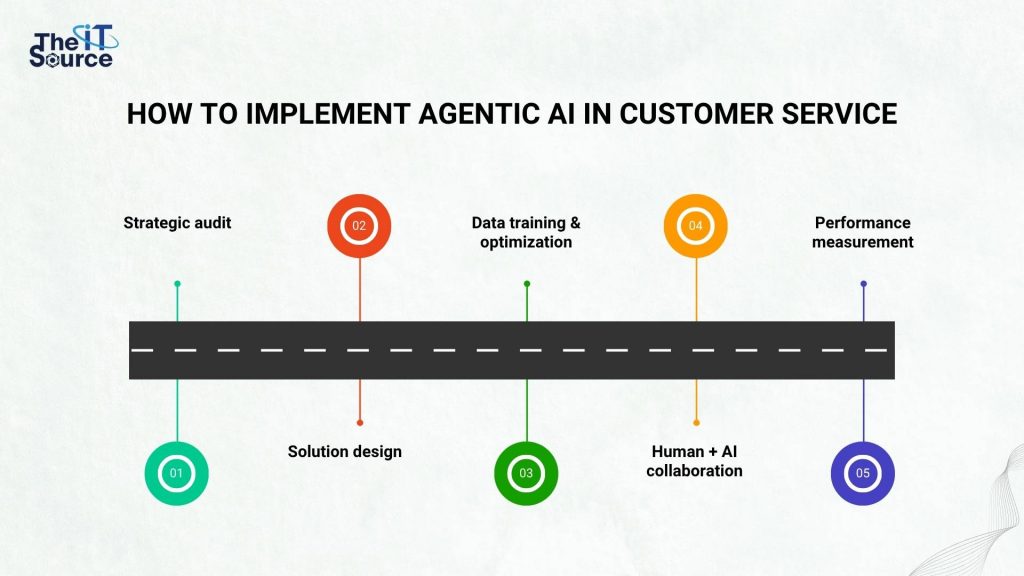
Step 1: The strategic audit – Pinpoint your high-impact opportunities
Before jumping into implementation, we begin by evaluating your current operations to identify the areas where AI will have the most immediate and significant impact. We analyze your workflows to uncover friction points and pinpoint tasks ripe for automation.
Is your team overwhelmed by high-volume inquiries? Are repetitive tasks consuming valuable agent time? A comprehensive audit helps us determine the best starting points, such as:
- High-volume, low-complexity FAQs
- Repetitive processes like order status updates or data entry
- Complex workflows requiring coordination across multiple systems
Step 2: Solution design – Choose the right AI partner and platform
Once opportunities are identified, we select the right solution. Not all AI platforms are the same, and the key is to choose a partner whose technology aligns with your goals and infrastructure.
Critical factors to consider include:
- Scalability: Can the platform grow with your business?
- Integration capabilities: Does it connect seamlessly with your core systems (CRM, ERP, ticketing)?
- Customization: Can it be tailored to your unique business needs?
The TIS platform is built on these principles, offering a flexible foundation for smooth implementation with minimal disruption.
Step 3: Data training and optimization – Build your AI’s intelligence
An AI system is only as powerful as the data it learns from. A crucial part of our implementation process is training the system with your historical data and real customer interactions. This ensures the AI understands the context, intent, and nuances of your customer conversations.
After launch, we continuously monitor performance and optimize the system with feedback from customers and agents. Over time, the AI learns and improves, becoming capable of handling more complex queries and delivering superior support.
Step 4: Human + AI collaboration – Empower your team
While agentic AI automates routine tasks, your human agents remain essential for handling complex or emotionally sensitive issues. We focus on creating a collaborative environment where AI acts as a “co-pilot” for your team. The AI assists by providing real-time data, suggesting solutions, and automating post-call tasks.
This collaboration allows your agents to focus on higher-value tasks, boosting productivity and job satisfaction.
Step 5: Performance measurement and iteration – Drive continuous value
Once your system is live, we relentlessly measure its impact. We track key performance indicators (KPIs) to prove value and identify areas for improvement, such as:
- Cost savings: Compare operational costs before and after AI implementation.
- Customer satisfaction (CSAT): Survey data to assess the quality of AI-driven interactions.
- Resolution and response times: Monitor how quickly issues are being resolved.
Your partner in AI transformation
As businesses strive to stay ahead in an ever-changing landscape, agentic AI in customer service is becoming a crucial part of a winning strategy. With the right implementation partner, you can unlock the full potential of this transformative technology, turning a futuristic idea into a tangible driver of growth and innovation.
Ready to transform your customer service operations with agentic AI? Contact TIS today to schedule a demo and see how our proven implementation process can drive real, lasting results for your business.