

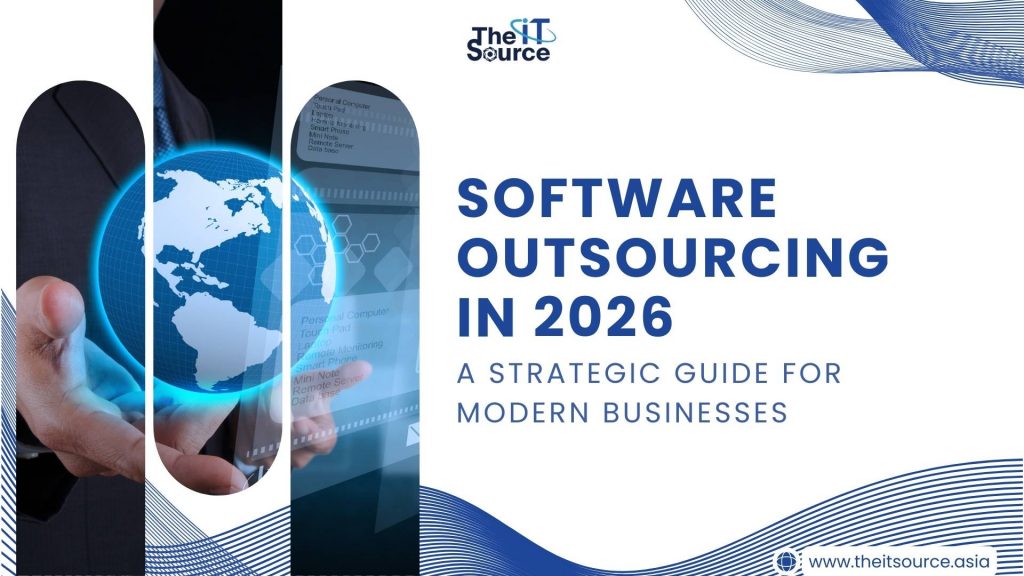
Software Outsourcing in 2026: A Strategic IT Outsourcing Guide
Software outsourcing has entered a new era. Once viewed mainly as a cost-saving tactic, it has now become a strategic growth engine for businesses navigating rapid digital transformation, AI adoption, global talent shortages, and increasingly strict compliance frameworks such as GDPR and the EU AI Act.
According to the European Commission, the EU AI Act introduces a risk-based framework that directly affects how software systems are developed, deployed, and outsourced, especially for businesses operating across borders.
For leaders in Japan and Europe, the question is no longer “Should we outsource?” but “How can software outsourcing strengthen innovation, accelerate delivery, and ensure compliance?”
This comprehensive guide examines how software outsourcing and the broader landscape of IT outsourcing software and software IT outsourcing is evolving in 2026, and how businesses can build long-term competitive advantages through the right offshore partnership.
The New Reality of Software Outsourcing
Today’s enterprise technology environment is defined by speed, complexity, and accountability. Digital products must evolve quickly, infrastructure must scale globally, and data must remain secure under strict regulatory environments. This shift has dramatically elevated expectations for software outsourcing partners.
Modern businesses no longer seek teams that simply “execute tasks.” They expect partners that contribute to strategic business outcomes, not just labor. This trend is reflected in broader industry shifts: for example, in a report by Reuters, major outsourcing firms such as TCS are redefining their workforce strategies in response to AI-driven transformation in the $283 billion global outsourcing sector — moving away from low-value routine tasks toward higher-value technology engagements. In this context, software outsourcing partners are increasingly evaluated not by cost alone but by their ability to drive product value and innovation. Software outsourcing has transitioned from a transactional model into a capability-building strategy, enabling companies to innovate faster while maintaining compliance and cost efficiency.
This evolution has also influenced how businesses evaluate outsourcing destinations. Markets like Vietnam, with strong engineering talent, cultural compatibility, disciplined delivery, and bilingual English–Japanese capabilities, are becoming preferred hubs for long-term software outsourcing.
Key Trends Redefining Software Outsourcing in 2026
1. Product-Focused Engineering Becomes the Standard
The most profound shift in software outsourcing is the expectation that offshore developers behave like product contributors, not task executors. Indeed, recent industry moves show clients prioritizing specialization and innovation: according to MarketWatch, leading outsourcing provider Infosys recently raised its sales guidance three times as demand for AI-enabled and advanced technology services continues to grow among enterprise clients. This demonstrates how outsourcing has evolved from commodity delivery to strategic collaboration on core technology solutions. Teams must understand user journeys, business logic, and long-term product goals to deliver meaningful value.
Businesses increasingly require developers who can:
- Identify risks early and propose alternatives.
- Optimize architecture for scalability and cost.
- Challenge assumptions when requirements are unclear.
- Collaborate directly with product managers and designers.
This evolution means software outsourcing is now deeply tied to product maturity. Companies want teams that “think before they code,” ensuring outcomes match both technical and business priorities.
2. Demand for Deep Technical Specialists Surges
Businesses no longer build large generalist teams offshore. Instead, they seek compact, high-skill units that excel in specific technologies. Shortages in AI engineering, cloud-native development, DevOps, data engineering, mobile development, and cybersecurity have accelerated this shift.
Regional markets differ in how quickly they adapt, but Vietnam stands out due to:
- Fast adoption of new technologies,
- Strong foundational engineering skills,
- High discipline and delivery consistency,
- Cultural and working-style alignment with Japan and Europe.
This makes Vietnam a prime destination for both software IT outsourcing and more advanced IT outsourcing software initiatives.
3. AI Is Now at the Core of Outsourcing Delivery
AI has fundamentally changed development workflows. Businesses expect outsourcing partners to embed AI directly into the software development lifecycle, speeding up delivery and elevating quality.
AI-driven outsourcing now includes:
- Automated test generation and test execution.
- AI-assisted code review and debugging.
- Prediction of delivery risks and performance bottlenecks.
- AI Workers performing operational tasks without requiring API access.
This not only accelerates product development but also reduces operating costs. Vendors like The It Source stand out by offering Agentic AI, AI Worker automation, AI customer service, and on-premise AI deployment options critical for businesses with strict compliance needs.
4. Hybrid Outsourcing Models Become the Norm
The traditional single-location outsourcing model has become less effective for complex enterprise environments. Hybrid approaches combining onshore governance, nearshore collaboration, and offshore scalability are becoming the standard.
A hybrid model allows businesses to:
- Maintain strategic oversight locally.
- Conduct real-time collaboration through nearshore teams.
- Scale rapidly and cost-effectively through offshore engineering.
Vietnam’s offshore teams integrate naturally into hybrid setups thanks to strong Agile practices, extended working-hour overlaps, and bilingual communication, making them ideal for large-scale software outsourcing.
5. Compliance and Security Drive Vendor Selection
GDPR, APPI, ISO 27001, and especially the EU AI Act have made compliance non-negotiable. Outsourcing vendors must demonstrate advanced data governance, audit-ready operations, and security-by-design methodologies.
Modern businesses require:
- Strict access control and change tracking.
- Encrypted data environments.
- Clear models for handling sensitive data.
- On-premise or private-cloud deployment options.
- Documentation aligned with EU AI Act risk classifications.
Businesses in regulated sectors finance, healthcare, logistics, and insurance, now prioritize outsourcing vendors capable of maintaining these standards. This is where The It Source excels: its software outsourcing framework is built around compliance-first engineering.
Market Insights: Why Software Outsourcing Is Accelerating
Global studies show the rapid expansion of software outsourcing:
- The global IT outsourcing market is expected to exceed $600 billion in 2026.
- More than 90% of large businesses in the EU and Japan rely on outsourcing for critical digital initiatives.
- Offshore engineering teams provide 40 – 60% cost optimization.
- Hiring offshore engineers takes 1- 2 weeks, compared to 8 – 12 weeks locally.
- Over 70% of outsourced systems now run on cloud-native architectures.
- AI-assisted development improves productivity by 20 – 40% on average.
These numbers highlight a clear trend: software outsourcing has matured from a cost-saving measure into a long-term strategic enabler.
How Businesses Benefit from Modern Software Outsourcing
The value proposition of outsourcing has expanded significantly beyond cost reduction.
- Faster access to specialized talent: Global shortages in AI, cloud, DevOps, backend engineering, and QA automation make offshore talent pools critical to product scalability.
- Acceleration of time-to-market: Software outsourcing provides continuous development cycles, predictable delivery, and flexible team expansion all essential in industries competing on speed.
- Operational focus and clarity: By delegating technical complexity to an expert partner, internal teams can dedicate their energy to strategy, customer experience, and market expansion.
- Long-term product stability: With the right vendor, knowledge retention and product continuity are maintained across years not months, reducing operational risk.
This shift aligns closely with the strategic priorities of Japan and Europe, where quality, predictability, and governance matter more than headcount alone.
The Risks Businesses Must Address and How to Mitigate Them
Outsourcing is powerful, but not risk-free. The most common risks include communication gaps, inconsistent quality, and compliance vulnerabilities.
Businesses must ensure their outsourcing partner provides:
- Bilingual communication capabilities.
- Transparent Agile methodology and documentation.
- Automated testing and code review standards.
- Compliance-ready processes aligned with GDPR and the EU AI Act.
The It Source addresses these challenges through product-focused engineering, bilingual Japanese, English teams, AI-supported development workflows, and enterprise-grade security frameworks.
Why Vietnam Has Become a Premier Software Outsourcing Hub
Vietnam now stands among the top global destinations for software outsourcing due to:
- Strong engineering talent focused on quality.
- Rapid adoption of emerging technologies.
- Cultural compatibility with Japan and Europe.
- High stability and low attrition rates.
- Competitive pricing for premium technical capability.
This combination creates a delivery environment that balances cost, quality, and long-term continuity something many outsourcing destinations struggle to provide.
Strategic Takeaways
Software outsourcing in 2026 is no longer a reactive cost solution. It is a strategic foundation enabling businesses to build capabilities faster, operate efficiently, accelerate innovation, and meet the highest compliance standards.
For Japanese and European businesses facing talent shortages, complex technology demands, and strict regulatory environments, choosing the right software outsourcing partner is critical.
The IT Source combines offshore engineering excellence, AI-powered productivity, strong compliance frameworks, and bilingual communication, making it one of the most strategic choices for enterprise-grade software outsourcing, IT outsourcing software, and software IT outsourcing.
Contact The IT Source today to help your enterprise scale smarter, faster, and safer in 2026.