

Top 10 AI Trends in 2026 Shaping the Future of Business
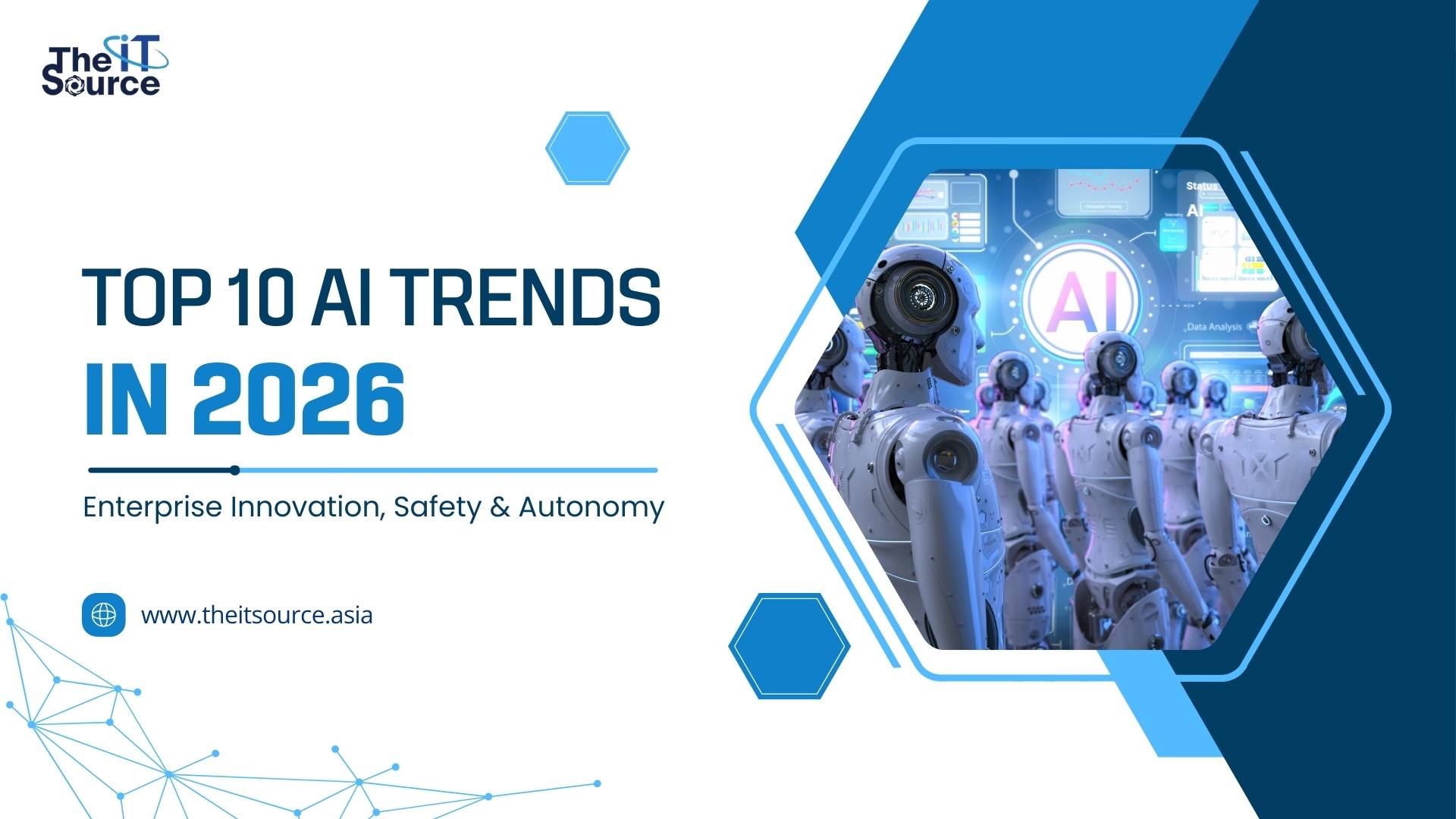
Artificial intelligence is entering a new phase defined not by experimentation but by safe, autonomous, and deeply integrated business use. For leaders in Europe and Japan, this shift presents both significant opportunities and increasing pressure. Markets are accelerating, customer expectations are rising, talent shortages are widening, and regulatory frameworks such as the GDPR and the EU AI Act require every AI-driven decision to be transparent, traceable, and accountable.
By 2026, AI will no longer operate at the edges of the organization. It becomes part of the core infrastructure that powers decisions, optimizes workflows, and supports complex operational ecosystems. Preparing for this reality requires strong governance, cross-functional readiness, and a clear understanding of where the technology is heading.
This article examines ten transformative AI shifts that are shaping global businesses in 2026 and provides a practical, compliance-aligned roadmap for scaling AI safely, delivering measurable ROI, and building a sustainable competitive advantage.
With this context in mind, the first major shift defining business AI in 2026 is the rise of Agentic AI.
Trend 1: Agentic AI
Agentic AI represents a significant step forward in business automation. Rather than stopping at content generation, these systems can interpret an objective, break it into clear steps, choose the most effective sequence of actions, and execute tasks with minimal human involvement. For organizations in Europe and Japan, this approach directly supports priorities such as transparency, traceability, and compliance with frameworks like the EU AI Act, where controlled autonomy is essential for safe deployment.
Agentic AI is already reshaping daily workflows across key functions:
- Customer Service: Handling complex inquiries, retrieving information instantly, routing cases to the right teams, and escalating sensitive issues with consistent logic.
- Supply Chain: Adjusting delivery routes in real time, improving demand forecasting, and coordinating suppliers for smoother operations.
- Finance: Monitoring AML alerts, detecting subtle fraud patterns, and supporting continuous, accurate compliance checks.
- HR & IT: Managing access permissions, guiding structured onboarding, and automating recurring infrastructure tasks.
As autonomy increases, governance becomes the foundation of safe adoption. Businesses need human oversight for critical decisions, detailed audit logs, transparent reasoning processes, and dependable fallback mechanisms. These controls ensure organizations can scale autonomous systems confidently while maintaining compliance and operational stability.
Trend 2: Human–AI orchestration skills
As AI becomes embedded in more business activities, employees are no longer just “users” of technology. They are becoming orchestrators who guide AI systems, shape decision logic, and determine how automated outputs integrate into real workflows. Human–AI orchestration emphasizes the ability to frame problems clearly, provide context that AI cannot infer, and establish the boundaries within which AI should operate. This shift reflects an important transition identified in Accenture’s insights on the future workforce, where human roles increasingly center on supervising and directing intelligent systems rather than executing routine tasks.
These skills are proving especially valuable in areas where human context enhances the quality of AI decisions:
- Marketing and sales: Guiding AI on tone, audience intent, and relevance to ensure personalization is meaningful rather than mechanical.
Research and analytics: Evaluating AI-generated insights, validating assumptions, and ensuring conclusions are grounded in business reality. - Software development: Deciding when AI-generated code is appropriate, adjusting logic, and ensuring alignment with architecture and security standards.
- Operations and support: Interpreting customer sentiment, refining escalation rules, and resolving cases where AI needs human judgment.
As AI expands across the business, the quality of outcomes increasingly depends on how effectively humans can supervise and shape automated decisions. Employees must understand when to trust AI, when to question it, and when to override it entirely. This balance helps organizations maintain fairness, consistency, and compliance, which is essential in Europe and Japan, where regulatory expectations continue to rise.
The IT Source enhances this capability through offshore development teams that can work closely with business stakeholders to refine AI workflows, conduct bilingual evaluations, and ensure systems operate reliably across both Japanese and English environments. This human-centered approach enables organizations to unlock the value of AI while maintaining control and confidence in the decision-making process
Trend 3: AI-Driven workplace transformation
AI is transforming the workplace by making everyday coordination smoother, faster, and more intuitive. Instead of relying on manual check-ins or scattered communication, teams can now work within environments where AI highlights what matters, organizes information, and helps everyone stay aligned with less effort. This reflects a broader shift identified in the OECD’s analysis on AI and work, where intelligent tools enhance both clarity and productivity.
Where AI creates the most impact:
- Project coordination: Identifying bottlenecks early and recommending more effective task distribution.
- HR and workforce operations: Supporting screening, identifying engagement patterns, and improving planning decisions.
- Internal communication: Summarizing long discussions and turning them into clear next steps.
- Operational stability: Providing timely alerts and suggestions that prevent problems before they escalate.
By helping teams work with greater focus and less friction, AI-driven workplace transformation unlocks a more fluid, responsive, and resilient way of operating. The IT Source supports this shift with AI-enabled solutions and offshore development teams that help organizations modernize internal workflows with precision and clarity.
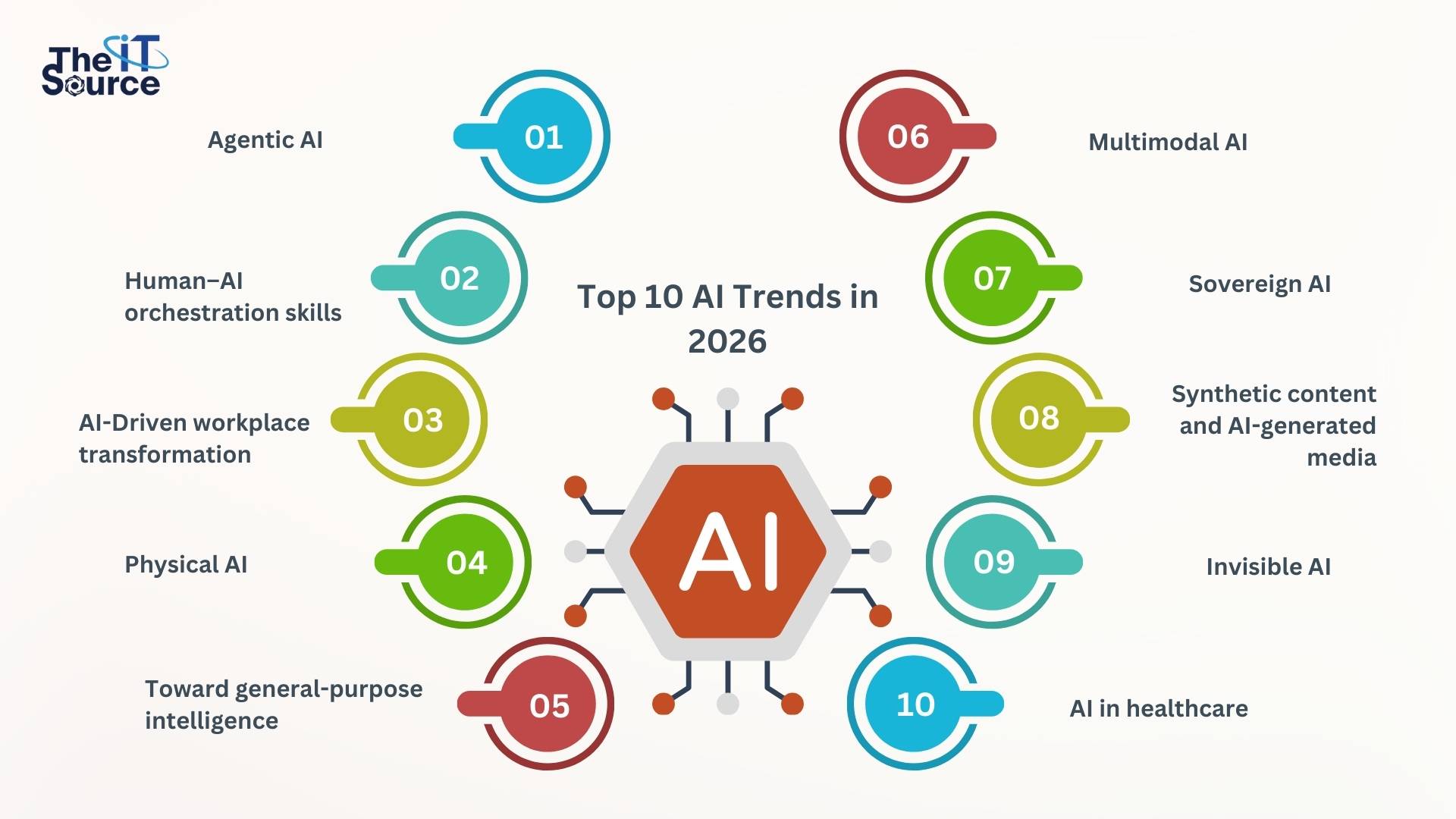
Trend 4: Physical AI
Physical AI brings intelligence into the physical world by allowing machines to sense their surroundings, interpret what is happening, and respond with precision. Instead of depending solely on predefined automation, these systems adjust to real-time conditions in ways that traditional rules-based systems cannot. This makes physical AI especially valuable in environments where accuracy, speed, and consistency directly influence performance.
How Physical AI enhances daily operations:
- Manufacturing: Vision-guided inspection enables the detection of defects earlier, thereby improving product consistency.
- Logistics: Smarter warehouse coordination supports smoother flows and reduces human-driven errors.
- Healthcare: Continuous monitoring and early detection tools ease clinical workloads and enhance patient care.
- Smart infrastructure: Adaptive traffic and energy systems improve safety, reliability, and resource efficiency.
As physical AI becomes more capable, strong oversight becomes increasingly important. Clear operational boundaries, transparent decision trails, and dependable fallback mechanisms help ensure these systems remain predictable even in dynamic environments. When governed effectively, physical AI becomes a strategic asset that enhances stability, improves quality, and supports more resilient operations.
Trend 5: Toward general-purpose intelligence (AGI Progress)
AGI refers to AI systems that can understand, learn, and reason across different domains rather than focusing on a single task. While full AGI remains an evolving concept, meaningful progress is already evident in models that combine reasoning, multimodal understanding, and problem-solving. These advances are enabling AI systems to undertake more complex cognitive tasks and support breakthroughs in research and decision-making.
Where early AGI-like capabilities are emerging:
- Scientific discovery: Models can analyze data, generate hypotheses, and support rapid experimentation.
- Creative development: AI assists with design, simulation, and concept generation across multiple media formats.
- Strategic problem-solving: Systems can evaluate scenarios, weigh alternatives, and provide structured recommendations.
- Cross-functional workflows: AI integrates information from different departments to support more holistic decision-making.
These early forms of general-purpose intelligence introduce new opportunities but also call for thoughtful governance. Organizations must understand how these systems reach conclusions, ensure results remain accountable, and maintain clear oversight. When managed responsibly, AGI progress becomes a catalyst for innovation and a powerful complement to human experThe IT Sourcee.
Trend 6: Multimodal AI
Multimodal AI represents a significant advancement, enabling systems to comprehend and integrate multiple forms of information, including text, images, audio, and video. Instead of analyzing each input separately, these models interpret them together to form a richer and more accurate understanding of context. The progress demonstrated in Google DeepMind’s Gemini technology shows how quickly multimodal capability is becoming practical for business use.
Where multimodal AI creates high value:
- Customer insights: Interpreting conversations, visual cues, and sentiment to understand customer needs more holistically.
- Security and operations: Reviewing camera footage, audio signals, and system data to detect anomalies more reliably.
- Healthcare diagnostics: Combining medical images, lab data, and clinical notes to support early detection and care decisions.
- Quality assurance: Evaluating products visually and contextually to improve accuracy in inspection processes.
As multimodal systems integrate into business environments, organizations must establish clear guidelines for ensuring accurate interpretation, effective data governance, and robust oversight. When these foundations are in place, multimodal AI unlocks deeper insights, helping teams make better decisions with greater confidence.
Trend 7: Sovereign AI
Sovereign AI represents a growing movement toward maintaining local control over AI models, data, and infrastructure. As regulations evolve and concerns around privacy and security increase, organizations are placing greater emphasis on how data is governed and where AI systems are deployed. This direction aligns with principles outlined in the EU Data Governance Act, which highlights the importance of trusted data environments and transparent access frameworks.
Where Sovereign AI delivers meaningful value:
- Stronger data protection: Sensitive information remains within controlled environments and adheres to local governance rules.
- Regulatory alignment: Reduced risk of non-compliance with cross-border data restrictions.
- Operational independence: AI systems remain resilient even when external platforms or global providers face disruption.
- Long-term innovation stability: Organizations gain a predictable foundation on which to scale advanced AI capabilities.
Sovereign AI is ultimately about confidence and control. When businesses design AI ecosystems that respect data boundaries and embed transparent oversight, they strengthen both trust and long-term reliability. This approach ensures that innovation continues without compromising safety, privacy, or strategic independence.
Trend 8: Synthetic content and AI-generated media
Synthetic content is rapidly becoming a core part of modern communication. AI can now generate video, audio, imagery, and entire creative variations in seconds, allowing teams to experiment and refine ideas with far greater speed. These tools enable organizations to express concepts visually, prototype messages quickly, and scale content production without the traditional time and cost constraints.
Where synthetic content enhances real workflows:
- Marketing and branding: Producing campaign variations, visual assets, and product demos with consistent quality.
- Training and education: Generating instructional videos, voice-overs, and localized learning materials more efficiently.
- Media and entertainment: Supporting early-stage ideation through AI-assisted storyboards, concept art, and creative drafts.
- Product development: Creating 3D mockups and visual simulations that accelerate early design decisions.
As synthetic media becomes increasingly widespread, responsible guidelines are essential. Clear standards around authenticity, usage rights, and content verification help ensure that AI-generated materials remain trustworthy and aligned with organizational values. When managed well, synthetic content expands creative possibilities and supports faster, more adaptive communication across the business.
Trend 9: Invisible AI
Invisible AI refers to intelligent systems that operate quietly in the background, supporting daily activities without requiring constant commands or visible interfaces. Instead of waiting for instructions, these systems observe context, learn user patterns, and act at the right moment. The result is a more natural, fluid experience where technology enhances tasks without getting in the way.
Where Invisible AI creates meaningful impact:
- Smart workspaces: Lighting, temperature, and energy use are automatically adjusted to enhance comfort and minimize waste.
- Personal assistance: Schedules, reminders, and task prioritization happen proactively, helping users stay focused on higher-value work.
- Mobility and transportation: Traffic flows adjust in real-time, and route suggestions become more intuitive, improving travel efficiency.
- Connected living: Home devices learn preferences and adjust environments seamlessly, removing the need for constant manual adjustments.
The strength of Invisible AI lies in its subtlety. When systems understand context well enough to act without being prompted, they reduce friction and create environments that feel more responsive and human-centered. To ensure trust, organizations still need clear rules around data handling, transparency, and user control, even when the intelligence behind the experience remains largely unseen.
Trend 10: AI in healthcare
AI is reshaping healthcare by helping clinicians make earlier discoveries, optimize workflows, and deliver a more personalized patient experience. Instead of relying solely on manual interpretation or fragmented data, AI systems support medical teams with faster insights and a more complete clinical context.
Where AI is delivering the strongest impact:
- Early detection: Imaging models help identify abnormalities more quickly and consistently.
- Personalized treatment: Patient histories, genomic information, and clinical notes are analyzed to suggest tailored care plans.
- Patient support: Virtual assistants help with medication reminders, symptom tracking, and post-discharge guidance.
- Resource planning: Predictive models enable hospitals to forecast admissions, optimize capacity, and mitigate bottlenecks.
Because healthcare involves sensitive data and high-stakes decisions, governance remains crucial to the safe adoption of these practices. Organizations must adhere to strict data protection rules, such as the GDPR and Japan’s APPI, align with emerging frameworks like the EU Health Data Space, and ensure that AI-driven recommendations are explainable, traceable, and clinically accountable. When paired with strong oversight, AI becomes a powerful ally that enhances diagnostic accuracy, reduces administrative burden, and elevates the overall patient experience.
Conclusion
In 2026, AI is no longer defined by individual tools or experimental projects. It is becoming an intelligent layer that strengthens decision-making, simplifies operations, and supports employees across every function. From agentic systems and multimodal reasoning to synthetic content and healthcare innovation, these ten trends reflect a shift toward AI that is more capable, more integrated, and more aligned with real-world business needs.
For businesses, the opportunity is clear. AI can accelerate workflows, enhance customer experience, reduce operational friction, and support greater accuracy and resilience. But realizing these benefits requires more than adopting advanced models. It demands structured governance, clarity around data use, and teams that understand how to collaborate effectively with intelligent systems.
The IT Source supports organizations throughout this journey. Through AI automation solutions, agentic AI platforms, and bilingual offshore development teams, The IT Source helps businesses build safe, scalable, and compliance-aligned AI foundations that drive measurable business value.
If your organization is exploring how to adopt AI more strategically or preparing to scale existing initiatives, The IT Source is ready to help. Contact The IT Source to discuss your roadmap and unlock the next stage of your AI transformation.