

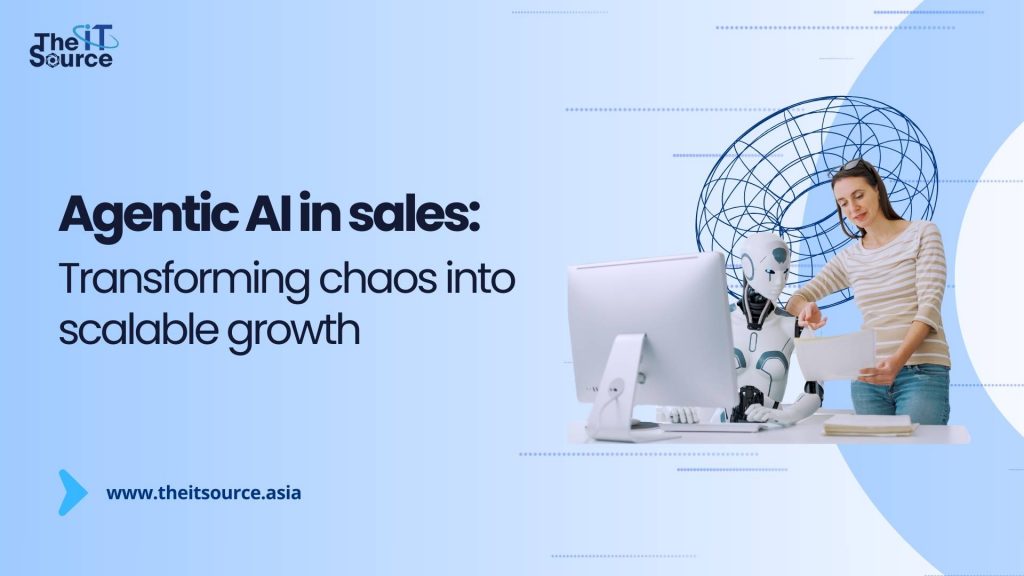
Agentic AI in sales: Transforming chaos into scalable growth
If you’re a senior leader today, you know the frustrating truth: your sales team is consistently hitting a ceiling. Scaling performance is non-negotiable, yet you’re spending fortunes on systems that still leave valuable people bogged down in costly, slow, and repetitive work. From wrestling with difficult leads and navigating long sales cycles to absorbing high acquisition costs, the daily friction created by high-volume, low-impact tasks is eating away at your reliable growth.
It’s time to escape that trap. Agentic AI in sales is the strategic pivot you need. This technology introduces truly autonomous AI agents that don’t just follow rules; they think, adapt, and proactively execute complex, multi-step sales processes with minimal human input. By embracing this AI-driven autonomy, you’re not just cutting costs; you’re transforming operational chaos into predictable efficiency and deep customer engagement.
At The IT Source, we specialize in making this future a secure reality for B2B businesses. We focus on the architectural precision needed for compliance and data security, guiding your shift from fragmented, manual systems to seamless, autonomous workflows that guarantee long-term value.
What is agentic AI and why does it matter for sales?
In today’s fast-paced and competitive sales environment, even the most advanced CRM systems and automation stacks may still leave your top talent overwhelmed by repetitive, low-value tasks. Traditional methods help with some aspects of the sales process but fall short in addressing the core issue. That issue is the constant drain of high-volume, repetitive work that consumes valuable time and resources. This friction creates a barrier to the strategic activities that drive true growth.
This is where agentic AI steps in. By transforming the way sales processes are executed, it shifts the focus from simply assisting to achieving genuine autonomy in sales workflows.
Defining true autonomy: The digital co-pilot
Agentic AI refers to a sophisticated form of artificial intelligence that goes beyond basic task automation. It doesn’t just follow instructions; it learns, adapts, and makes independent decisions to achieve complex sales goals. Unlike traditional tools, agentic AI agents can autonomously manage entire sales subprocesses, such as lead qualification, multi-step follow-ups, and even elements of deal closure, with minimal human intervention.
Why agentic AI is your strategic imperative
Agentic AI is becoming a strategic imperative for modern sales teams because it solves two critical problems:
1. Eliminating Inefficiency
By automating high-volume tasks like data entry, scheduling, and routine follow-ups, agentic AI liberates your sales team to focus on high-value activities such as relationship-building, strategy development, and complex negotiations. These activities directly impact revenue and growth.
2. Enabling Scalable Growth
With its ability to continually adapt to real-time data and customer behavior, agentic AI ensures that every interaction is personalized, responsive, and optimized for conversion. It allows your business to scale reliably and sustainably, removing the manual constraints that limit growth potential.
In essence, agentic AI empowers your sales teams to move beyond simply working harder. It allows them to work smarter, transforming complexity into predictable performance.
The core benefits of agentic AI in sales
For senior executives, the decision to invest in agentic AI in sales is no longer just about adopting a new technology. It is a strategic move to reduce risk, guarantee consistent performance, and ensure that every resource in the organization contributes to maximum return on investment. The following five benefits explain why agentic AI is becoming the defining force behind the transformation of global sales operations.
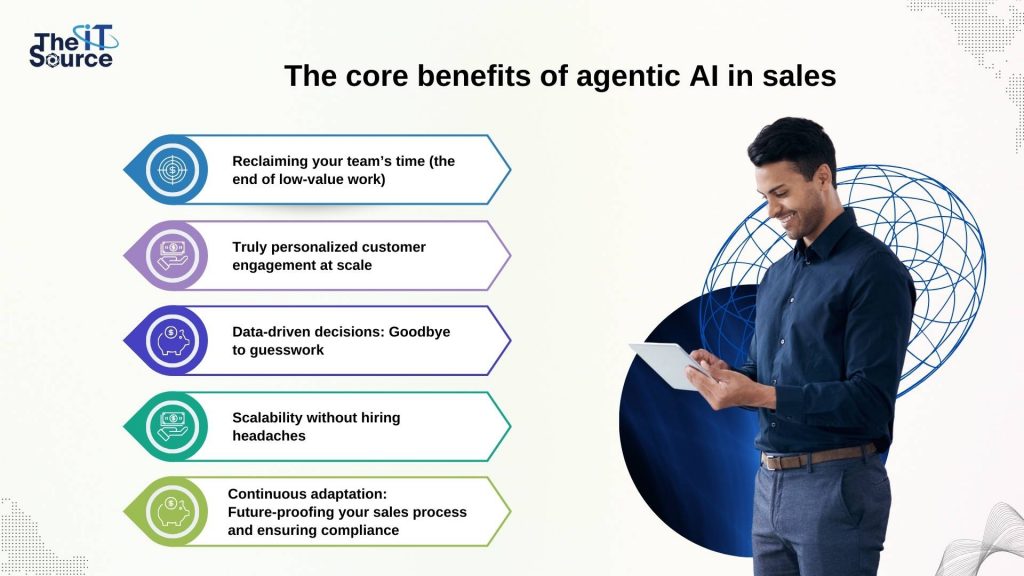
1. Reclaiming your team’s time (the end of low-value work)
Every week, high-performing sales professionals spend hours on tasks that are essential but not strategic. Constant CRM updates, follow-up emails, scheduling, and routine data entry consume valuable time that should be spent closing deals or strengthening relationships.
Agentic AI transforms this dynamic completely. It automates repetitive, low-value work, allowing sales professionals to focus on high-impact activities such as negotiation, strategy, and customer engagement. This shift immediately improves productivity and reduces human error while restoring time and energy to where it drives real results.
2. Truly personalized customer engagement at scale
Today’s buyers expect more than just service; they expect to be understood. Yet delivering personalized interactions across hundreds or thousands of leads remains a challenge for most sales teams. Agentic AI changes that reality.
By analyzing customer data in real time, AI agents can adjust tone, timing, and content to match each customer’s needs. They can nurture leads proactively, recommend products intelligently, and provide instant contextual support through conversational interfaces. This level of personalization strengthens trust, deepens engagement, and leads to higher conversion rates and long-term customer loyalty.
3. Data-driven decisions: Goodbye to guesswork
Modern markets evolve faster than ever, and instinct alone is no longer enough to guide sales strategy. Agentic AI replaces intuition with insight by analyzing large and complex data sets in real time. It identifies hidden trends, evaluates opportunities, and provides actionable intelligence that drives precise decision-making.
Sales teams can plan and act with confidence, knowing that every forecast and initiative is grounded in reliable data. This data-driven approach enables organizations to anticipate change, adapt strategies quickly, and make every resource count.
4. Scalability without hiring headaches
Growth often brings operational strain. Expanding teams to meet higher demand can be expensive and difficult to manage. Agentic AI removes these limitations by scaling sales operations without increasing headcount.
As businesses enter new markets or face seasonal spikes, AI agents handle larger workloads effortlessly. They manage customer interactions, lead qualification, and communications across multiple languages and channels with consistent accuracy. This capability allows companies to maintain high performance levels during periods of rapid growth while preserving efficiency and cost control.
5. Continuous adaptation: Future-proofing your sales process and ensuring compliance
Traditional systems begin to lose relevance the moment they are implemented. In contrast, agentic AI evolves continuously. It learns from each customer interaction, market trend, and operational outcome, refining performance over time and keeping your sales process aligned with changing realities.
A recent study from the UAB Collat School of Business highlights this progression, emphasizing that AI technologies are helping to augment every phase of the sales process, especially in complex B2B sales. The research further predicts that AI will handle 60 percent of all sales tasks by 2028, up from 45 percent in 2023, signaling a major transformation in how organizations approach sales.
This ability to learn and adapt makes agentic AI a long-term strategic asset. The IT Source specializes in setting up these autonomous systems with architectural precision, ensuring your sales organization remains relevant, competitive, and capable of compounding value year after year through smarter decisions and optimized performance, all while maintaining strict data security and compliance standards.
Practical applications of agentic AI in sales
Understanding the theory of agentic AI is only the first step. The true transformation begins when these autonomous systems are applied to real business challenges. Across industries such as finance, logistics, and technology, agentic AI in sales is reshaping how teams engage prospects, prioritize leads, forecast performance, and deliver highly personalized customer experiences.
Below are practical applications that show how this technology drives measurable business results — illustrated through real-world examples from The IT Source’s case study.
1. Autonomous lead management: Moving beyond volume to value
Lead management has long been a balancing act between speed and depth of engagement. Sales teams often have to choose between responding fast and engaging meaningfully. Agentic AI removes that trade-off.
AI agents autonomously capture, qualify, and nurture leads by analyzing behavioral signals, engagement history, and intent. When a potential buyer revisits a pricing page or downloads a whitepaper, the system can instantly reprioritize that lead and trigger a personalized follow-up. Every opportunity receives the right attention at the right time, ensuring no lead is lost in the noise.
In practice, this approach mirrors what The IT Source implemented for Giaonhan247, an e-commerce logistics company. Using vision AI, the The IT Source AI worker automated over 80% of repetitive order tracking tasks across platforms such as Amazon, eBay, and Etsy. By automatically updating order statuses and syncing with the internal system, the AI eliminated thousands of manual actions, enabling the sales team to focus entirely on nurturing high-value customers.
2. Adaptive sales forecasting and pipeline optimization
Forecasting has always been a challenge. Traditional methods rely heavily on static data and human interpretation, leaving room for bias and delay. Agentic AI introduces an adaptive model that continuously learns from data streams such as conversion rates, sales velocity, and market signals.
When close rates start slowing in a specific region or customer segment, the AI can immediately flag the anomaly and recommend adjustments in resource allocation or strategy. This creates a self-correcting sales ecosystem that helps leaders make confident, data-backed decisions — faster than ever before.
3. Guaranteed consistency: Enhanced customer conversations and 24/7 support
Every customer interaction defines your brand. Yet most sales teams struggle to maintain consistent quality due to time constraints or staffing limits. Agentic AI ensures continuous, context-aware engagement that scales globally.
During a live chat or call, the AI detects hesitation, analyzes intent, and suggests the best response in real time. Afterward, it automatically sends tailored follow-ups or documents to maintain momentum in the conversation.
A powerful example comes from Proship, a logistics company supported by The IT Source’s AI customer support agent. The system operates 24/7/365, registering new order requests, tracking shipments in real time, and notifying internal teams via Slack and email when priority inquiries arise. This always-on capability delivers reliability and responsiveness that no human team could sustain around the clock.
4. Cross-channel synchronization and CRM integration
Disconnected systems are one of the most common barriers to sales efficiency. Agentic AI eliminates this issue by acting as an orchestration layer that connects CRM platforms, marketing tools, and communication systems into a single ecosystem.
For example, when a prospect interacts on social media, that data is immediately synced to the CRM. The AI then triggers contextual actions, such as sending a personalized email or alerting the relevant sales representative. This real-time synchronization ensures that every touchpoint is consistent and that sales teams always operate with a complete, unified view of the customer journey.
5. Continuous learning from every touchpoint
The greatest strength of agentic AI lies in its ability to learn continuously. Every sales conversation, quote, or transaction becomes data that refines future decisions. Over time, the system identifies which strategies resonate with specific industries, customer profiles, or product lines.
This evolving intelligence enables AI to enhance playbooks, anticipate objections, and even predict customer churn before it happens. It turns sales operations into a living, learning process that improves performance and insight with each cycle. For leaders, this means more than efficiency — it means building a sales organization that grows smarter with every interaction.
Overcoming challenges in implementing agentic AI
While the transformative potential of agentic AI in sales is clear, executive-level commitment requires acknowledging and proactively addressing the inherent implementation challenges. For B2B leaders, especially in regulated sectors, these hurdles primarily involve architectural friction, data governance, and maintaining human control. These are the critical points where expert partnership becomes invaluable.
1. Integration complexity across fragmented systems
Enterprises often rely on complex, layered systems built over time (from CRMs and ERPs to marketing automation tools), each generating data in isolation. Integrating agentic AI into this ecosystem is rarely straightforward; fragmented data and disconnected workflows can prevent AI agents from acting autonomously and effectively.
The solution lies in establishing a system of execution (SoE) framework that connects disparate systems into a unified, AI-ready infrastructure. When integration is done right, data moves freely, decisions happen in real time, and AI delivers measurable efficiency gains. This structured approach, where the AI operates strictly within defined system boundaries, is something The IT Source has applied repeatedly in real-world projects, helping clients modernize legacy environments while preserving existing investments.
2. Data quality and responsible governance
AI systems can only perform as well as the data that fuels them. Inconsistent, outdated, or biased datasets can distort insights and undermine trust. Many organizations still underestimate the importance of rigorous data governance before implementing AI.
To sustain long-term success, enterprises must maintain data accuracy, compliance, and lineage across every process. For organizations operating under strict regulatory frameworks, such as those in the EU and Japan, GDPR and the EU AI Act set clear expectations for responsible AI deployment. The IT Source’s solutions are architected to support this with critical features like on-premise setup, ensuring that automation enhances compliance instead of jeopardizing it.
3. Building trust and strategic human oversight
Adopting AI autonomy often raises questions about transparency, ethics, and control. Leaders need to trust that AI-driven actions align with company standards and customer values.
The best approach is human-on-the-loop oversight: where AI acts as the co-pilot handling repetitive, high-volume decisions, and human talent focuses on supervision, refinement, and strategy. The The IT Source philosophy designs systems where the AI handles repeatable execution, but a human is always notified and available for support on complex or sensitive interactions (for example, the staff support AI agent notifies a human when it needs assistance). This model manages risk while amplifying human capacity.
4. Change management and skill gaps
Integrating agentic AI often triggers resistance rooted in uncertainty or lack of understanding. Sales teams may fear job displacement or doubt the system’s reliability. Effective change management is therefore crucial.
Executives should communicate the “why” behind AI adoption: framing it as a way to empower employees, not replace them. Training programs focused on data literacy, digital confidence, and collaborative workflows help teams adapt faster and work more effectively alongside AI systems. Organizations that invest early in reskilling and cultural adaptation tend to unlock faster returns and sustain long-term transformation momentum.
In essence, implementing agentic AI successfully requires leadership commitment, cultural readiness, and responsible governance. When these foundations are in place, businesses move beyond automation to create sales ecosystems that are intelligent, transparent, and continuously improving.
The Future of sales with agentic AI – A strategic partnership
The future of sales belongs to organizations that combine human creativity with AI-driven precision. In a world defined by speed, complexity, and global competition, traditional sales automation is no longer enough. Modern enterprises need systems that can think, adapt, and act intelligently, transforming sales operations from reactive to proactive and from fragmented to fully orchestrated.
Agentic AI is the catalyst driving this transformation. It redefines sales execution by enabling real-time decision-making, autonomous workflows, and continuous optimization. For forward-thinking leaders, this is not merely a technological evolution but a strategic inflection point. It represents an opportunity to rethink how value is created, measured, and sustained.
As more businesses adopt AI, success will increasingly depend on selecting the right strategic partner who combines deep technical mastery with business insight and a strong understanding of compliance requirements. Implementing agentic AI requires more than advanced technology. It demands experThe IT Sourcee in process design, market dynamics, and integration within regulated environments.
At The IT Source, we view agentic AI not as a tool but as a strategic enabler of enterprise growth. Our mission is to help organizations bridge the gap between automation and autonomy while ensuring that every implementation is secure, compliant, and optimized for measurable ROI. From data integration and process orchestration to on-premise deployment and GDPR compliance, we accompany our clients through every phase of their digital transformation journey.
The organizations that act now will define the next era of intelligent sales. Those who hesitate risk being left behind as markets evolve toward autonomy and precision. The question is no longer if agentic AI will transform your sales process, but when and with whom you will lead that transformation.
If you are ready to move beyond automation and build a sales organization that learns, adapts, and performs at scale, now is the time to begin.
Partner with The IT Source to make the future of autonomous sales a reality.