

Agentic AI in 2026: How Human–AI Collaboration Drives Growth
What if your next teammate isn’t human, but an intelligent system that learns, decides, and adapts alongside you?
By 2025, over 78% of global enterprises will have already integrated AI into their operations. The question is no longer whether AI should be part of your team, but how to collaborate with it effectively to drive measurable business value and long-term growth.
For business leaders across Japan and Europe, the challenge now lies in building partnerships with AI that are transparent, compliant, and sustainable.
This article examines how human–AI collaboration, driven by Agentic AI, is transforming teamwork, enhancing decision-making, and redefining business operations. You’ll discover the frameworks that ensure trust and compliance, as well as practical steps to design an AI collaboration model that delivers measurable results.
Human–AI collaboration: The new engine of business growth in 2026
Human–AI collaboration is no longer an abstract concept. It has become a core strategy reshaping how modern enterprises operate, innovate, and compete. At its heart lies synergy: a partnership where human intelligence and artificial intelligence unite to achieve outcomes that neither could reach alone.
Artificial Intelligence delivers precision, speed, and scalability. It processes vast amounts of data, identifies hidden patterns, and automates repetitive tasks with unmatched accuracy. Humans bring creativity, ethical judgment, emotional understanding, and strategic foresight. When these strengths converge, they create a powerful engine for innovation and sustainable growth.
Across industries, this collaboration already delivers measurable impact:
- In logistics, AI systems optimize routes and predict disruptions, while managers use those insights to balance cost efficiency with sustainability goals.
- In finance, predictive models detect anomalies and forecast market fluctuations, while experts interpret the results to ensure compliance and protect clients.
- In healthcare, AI analyzes patient data to support diagnosis, allowing doctors to focus on empathy, complex reasoning, and treatment planning.
Recent research published in Nature Scientific Reports reinforces this balance, showing that AI-assisted diagnosis significantly improves accuracy when guided by human expertise.
This evolution is not about replacement. It is about amplification. When AI handles the what and when, people can focus on the why and how. The result is a smarter, faster, and more resilient organization where technology enhances human capability instead of competing with it.
For businesses entering 2026, this synergy is no longer optional—it has become a decisive factor for growth. Markets are moving faster than ever; customer expectations continue to rise, and regulatory environments are becoming increasingly complex. Organizations that master human–AI collaboration gain the agility, resilience, and insight needed to thrive.
Key business benefits of human–AI collaboration:
- Enhanced productivity: AI automates repetitive tasks, freeing human talent for high-value, creative, and strategic work.
- Smarter decision-making: Real-time analytics enable faster, data-driven decisions across finance, logistics, and operations.
- Accelerated innovation: With AI managing routine processes, teams gain the time and clarity to experiment, collaborate, and deliver breakthrough ideas.
Ultimately, human–AI collaboration redefines how enterprises create value. It transforms data into decisions, automation into advantage, and human potential into a lasting competitive strength.
The transformative benefits of agentic AI
While human–AI collaboration unlocks synergy between people and machines, agentic AI represents the next leap forward. It extends beyond automation to create systems that can learn, reason, and act independently, aligning with human goals and governance standards.
Unlike traditional automation, agentic AI does not just follow programmed instructions. It makes context-aware decisions, learns from feedback, and continuously optimizes its performance. This creates a dynamic cycle of efficiency and innovation that drives measurable business outcomes.
1. Operational excellence and intelligent automation
Agentic AI enhances operational resilience by autonomously managing data-intensive, repetitive tasks. It ensures speed and accuracy across workflows while freeing human experts to focus on high-value initiatives.
For instance, a logistics client of TIS, Giaonhan247, used the Conductify AI platform to automate more than 80% of its order-tracking process across Amazon, eBay, and Etsy. The system updates shipment data in real-time and notifies teams of status changes, reducing manual workload and improving customer response time by over 70%.
In healthcare, agentic AI can process clinical records, flag anomalies, and alert medical staff before risks escalate. In finance, it strengthens compliance by identifying irregularities and maintaining transparent audit trails. Across industries, its goal is to increase precision while ensuring human teams remain focused on strategy and judgment.
2. Strategic insight and predictive intelligence
Beyond streamlining operations, agentic AI empowers organizations with strategic foresight. It transforms massive datasets into actionable intelligence, enabling leaders to anticipate market shifts, optimize resources, and make decisions grounded in evidence.
In the financial sector, predictive models simulate scenarios and recommend risk mitigation strategies, helping decision-makers act confidently within compliance frameworks. As these systems learn from real outcomes, they evolve into trusted partners capable of guiding long-term strategy.
3. Building customer loyalty through adaptive experiences
Agentic AI also transforms customer experience into a continuous, personalized journey. It anticipates customer needs, tailors interactions, and delivers consistent support without downtime.
A client in the logistics sector, Proship, leveraged TIS’s AI customer service agent to automate booking requests and container tracking through web and messenger channels. The AI integrated seamlessly with Slack and email, enabling real-time updates for internal teams and improving customer satisfaction through faster, more reliable communication.
By automating routine interactions, employees can dedicate more attention to empathy, relationship building, and problem resolution—areas that strengthen trust and long-term loyalty. The outcome is a service experience that feels human, even when powered by AI.
A strategic roadmap for successful human-AI collaboration
While integrating agentic AI brings transformative opportunities, realizing its full potential requires a thoughtful and proactive strategy. Success comes from aligning technology with people, processes, and purpose so that AI adoption enhances performance without disrupting the organization. The roadmap below outlines five essential pillars for building sustainable human–AI collaboration.
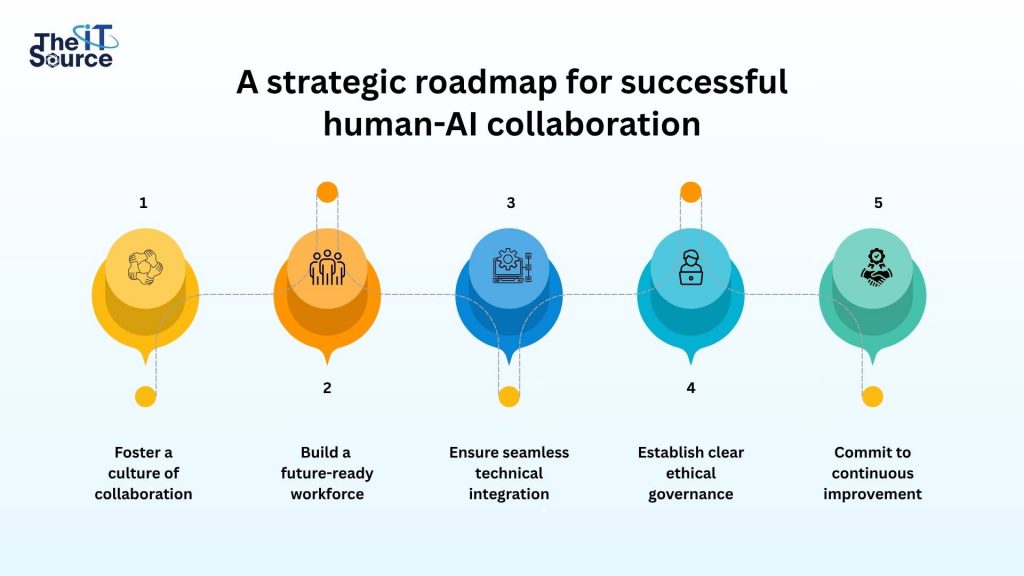
1. Foster a culture of collaboration
Every transformation begins with a mindset. When new technology enters the workplace, uncertainty often follows. The key is to help people understand that agentic AI is a partner designed to strengthen, not replace, human capability. When employees see how AI reduces repetitive tasks and creates space for creative and strategic work, trust in the technology grows naturally. A transparent approach encourages teams to experiment, learn, and find new ways to collaborate.
2. Build a future-ready workforce
Collaboration with agentic AI demands new skills. Teams must learn how to interpret data, oversee algorithms, and use insights to solve complex business problems. Investing in these abilities is an investment in long-term success. The World Economic Forum’s report highlights that analytical thinking, creativity, and AI literacy will define the next generation of professionals. By embedding these skills into everyday learning, organizations prepare their people to thrive alongside intelligent systems.
3. Ensure seamless technical integration
Agentic AI delivers value only when it works in harmony with existing systems and workflows. Before implementation, companies should assess how processes connect, identify areas of overlap, and ensure that data can move freely across departments. Standardizing formats and strengthening data quality help AI operate smoothly from day one. When systems communicate clearly, human and digital teams can achieve far greater efficiency together.
4. Establish clear ethical governance
As AI becomes more autonomous, ethics and accountability become vital. Transparent governance ensures that every AI decision aligns with corporate values and regulatory standards. Following frameworks such as the EU AI Act and GDPR safeguards data integrity and protects both customers and the brand. At The IT Source, each AI solution is designed with compliance at its core so that innovation always goes hand in hand with responsibility.
5. Commit to continuous improvement
Human–AI collaboration is a journey of constant learning. Organizations that regularly review system performance, collect user feedback, and refine workflows maintain alignment between business goals and technological progress. This cycle of reflection and adjustment enables AI to evolve in tandem with people, ensuring that both continue to learn, adapt, and deliver sustainable value over time.
The future of work: Redefining roles and culture with agentic AI
As we look toward 2026 and beyond, the integration of agentic AI is set to do more than just improve efficiency. It will fundamentally reinvent roles, team structures, and organizational culture. The future of work will be defined by a new, symbiotic partnership between human talent and AI collaborators.
-
The evolution of human roles: From execution to strategy
The nature of human work will shift from routine task execution to strategic oversight and innovation. As agentic AI assumes complex analytical and operational responsibilities, new, high-value human roles will emerge. We will see the rise of AI trainers, who fine-tune AI models; system ethicists, who ensure AI decisions align with human values; and strategic collaborators, who use AI-driven insights to pioneer new products and market strategies. This transition empowers employees to focus on contributions that require critical thinking, creativity, and emotional intelligence.
-
The rise of hybrid teams
The traditional concept of a “team” will expand to include both human and AI members working in fluid, dynamic structures. In this hybrid model, tasks will be allocated based on the unique strengths of each member—whether human or AI. This approach allows organizations to build highly adaptable and resilient teams that can respond to market changes with unprecedented agility.
-
A culture of continuous learning and adaptation
Ultimately, the most profound change will be cultural. Organizations that thrive will be those that foster a culture of continuous learning and adaptation. The integration of agentic AI creates a more resilient and inclusive workforce by automating repetitive tasks, reducing burnout, and creating more equitable opportunities for employees to engage in meaningful work. This environment not only boosts engagement but also ensures that the organization as a whole is prepared to evolve in tandem with technology.
As Forbes emphasizes, the future of human–AI collaboration depends on keeping technology aligned with human judgment, creativity, and ethics — not the other way around.
Build your future-ready organization with The IT Source
The integration of Agentic AI is no longer futuristic—it is a strategic imperative. The future belongs to organizations that master Human-AI collaboration to reinvent roles, build hybrid teams, and foster a culture of continuous adaptation.
This transformation requires more than just technology; it demands a strategic partner. At The IT Source, we bridge that gap. Our expertise in AI Automation Solutions and building empowered Offshore Development teams is designed to drive the efficiency, innovation, and sustainable growth this new era demands. We provide more than tools—we help you build a resilient, competitive advantage.
Are you ready to redefine your workplace? Contact us today to explore how we can build the future of your business, together.