


7 Hidden Costs of Offshore Development and How to Avoid Them
Is the $25/hour developer on your Excel spreadsheet an illusion? For many executives, the promise of massive cost savings with offshore development quickly fades when the final invoices arrive. This happens far more often than you’d think, and it’s almost always for the same reason.
The hidden costs offshore development are often overlooked initially, leading to chronic budget issues.
The sticker price is not the true price. While companies are drawn to global talent pools (a key driver for outsourcing according to the Deloitte Global Outsourcing Survey), they are often blindsided by a cascade of indirect expenses. These are the hidden costs of offshore development that turn anticipated savings into significant budget overruns.
This post cuts through the complexity. We will identify the seven most common hidden costs and provide an actionable framework to evaluate offshore outsourcing cost risks. You’ll walk away with a practical checklist to build a transparent and predictable offshore strategy, a foundational step in creating a successful global team as detailed in our guide at The IT Source.
Being aware of the hidden costs offshore development will help in making informed decisions for your project.
Offshore development versus true cost of ownership
To make a truly informed decision, leaders must shift their focus from the sticker price to the Total Cost of Ownership (TCO). The advertised hourly rate is just one variable in a much larger and more complex equation that determines your project’s actual financial impact.
Why the sticker price misleads executives
The fundamental mistake is confusing a tactical metric (the hourly rate) with a strategic one (the TCO). The TCO encompasses not only the vendor’s fees but all the internal and external expenses required to make the engagement successful. These are the costs related to management overhead, communication friction, quality assurance, and potential rework that don’t appear on the initial proposal.
For example, that $25/hour developer might seem like an incredible bargain. But once you factor in the additional project management hours needed to bridge time zones, the cost of hyper-detailed documentation to prevent misunderstandings, and a budget allocation for rework due to communication gaps, the effective rate often climbs closer to $40/hour.
Regional differences in hidden costs
This principle holds true globally, though the specific overheads may vary by region:
- India and Southeast Asia: Offer the lowest direct hourly rates but can carry higher indirect costs related to communication and project management.
- Eastern Europe: Rates are higher than in Asia, but better time-zone alignment for European and US East Coast teams can reduce communication overhead.
- Latin America: Provides excellent time-zone overlap for North American companies, which lowers communication friction, though direct rates are typically higher than in Asia.
- Vietnam: Competitive on price, but with much closer time-zone alignment for Japan and growing compliance maturity for European clients. This balance often reduces indirect costs compared to India while keeping overall costs more predictable.
The key takeaway: a lower hourly rate does not automatically equal a lower total cost.
Framework to evaluate hidden costs offshore development
At The IT Source, we advise our partners to move beyond simple rate comparison and adopt a structured framework for assessing offshore outsourcing cost risks. This creates a realistic benchmark of the real investment required. We group these costs into three primary categories:
Understanding the hidden costs offshore development will aid in risk management throughout the project lifecycle.
- Direct Costs: This is the “sticker price.” It includes the hourly rates for the engineers, specified contract fees, and any initial setup charges.
- Indirect Costs: These are the operational expenses required to support the offshore team. This category covers communication and collaboration tools, additional project management time, travel for in-person kick-offs, and the internal hours your team spends creating documentation.
- Risk Premium: This represents the potential financial impact of things going wrong. It includes the cost of rework due to defects, legal fees for contract disputes, risks to your intellectual property (IP), and expenses related to ensuring regulatory compliance (like GDPR or ISO 27001).
TIS Insight: By using this framework, you can build a comprehensive financial model that reflects the true TCO. This allows you to benchmark vendors based on their total value and risk profile, not just a misleading hourly rate.
7 hidden costs offshore development you must anticipate
While the hourly rate is the most visible number, the most significant expenses are often buried in operational inefficiencies and unmanaged risks. Here are the seven most common hidden costs of offshore development you need to anticipate.
Failure to anticipate the hidden costs offshore development can lead to significant financial setbacks.
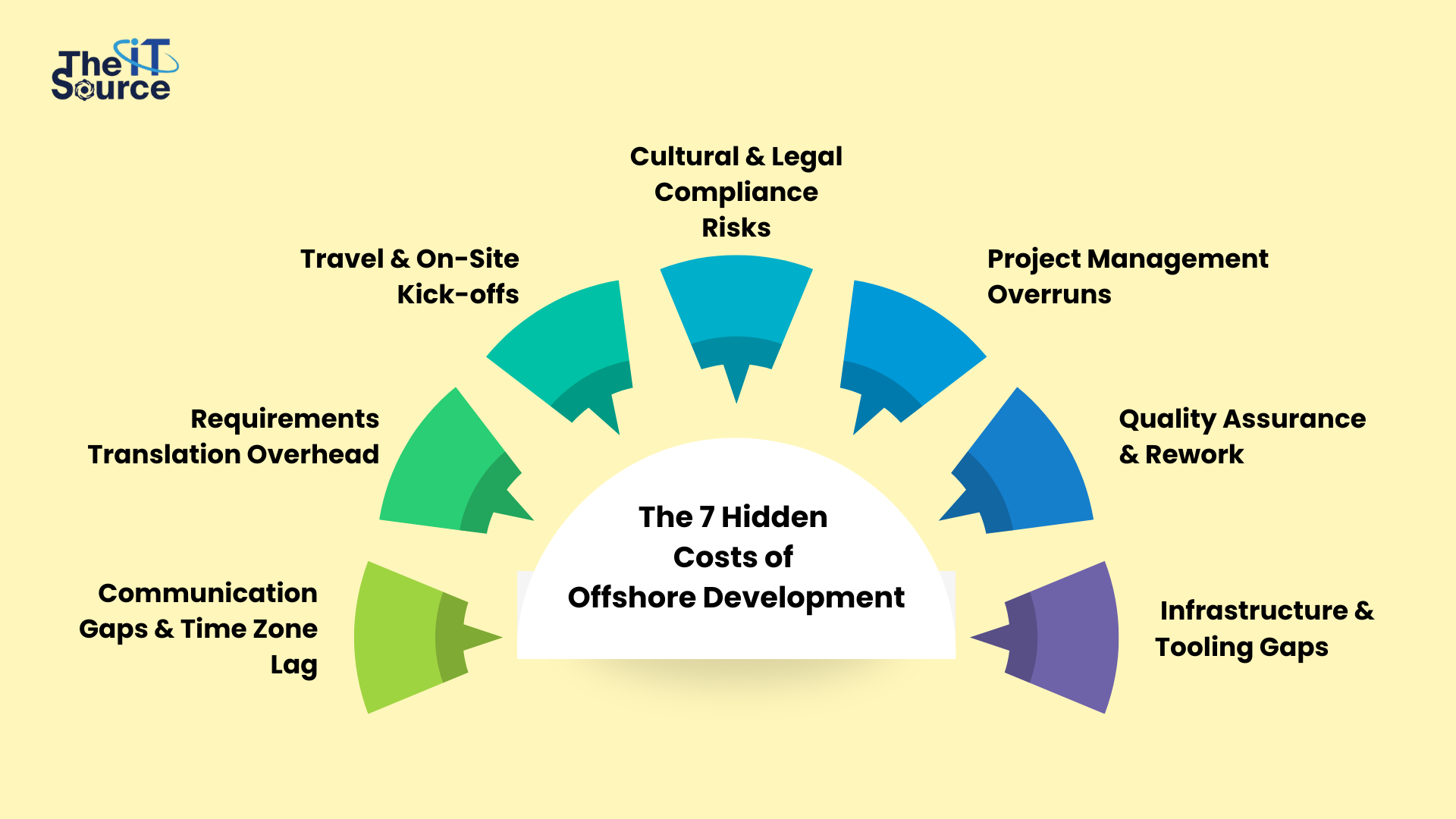
1. Communication gaps and time zone lag
The Problem: The most immediate challenge in any offshore engagement is bridging distance and time. Studies show that projects with teams separated by five or more time zones can experience an average productivity delay of 20% due to asynchronous communication.
The Impact: Simple questions can take 24 hours to get answered, halting progress. Nuanced requirements get lost in translation over email, leading directly to costly rework and missed deadlines.
How to Avoid It:
- Mandate Overlap: Require a minimum of 4 hours of daily overlap for real-time collaboration.
- Establish a Single Source of Truth: Use platforms like Jira or Azure DevOps to ensure everyone is working from the same information.
Addressing the hidden costs offshore development early can streamline communication and improve outcomes.
- Prioritize Bilingual Leadership: Ensure team leads and project managers on both sides are fluent in a common language to prevent misinterpretation.
2. Requirements translation overhead
The Problem: To protect themselves from scope creep, many offshore vendors require exhaustive documentation for every feature, including highly detailed user stories, process flows, and pixel-perfect mockups.
The Impact: This shifts a significant burden onto your internal Subject Matter Experts (SMEs). The hours they spend writing documents instead of focusing on their core responsibilities are a very real, though often untracked, hidden cost.
Not all offshore development projects account for hidden costs offshore development, resulting in unexpected challenges.
How to Avoid It:
- Use Interactive Prototyping: Tools like Figma and Miro allow for dynamic, visual collaboration that is often clearer than a 100-page document.
- Record Video Walkthroughs: A 15-minute screen recording where an SME explains a workflow can reduce documentation time by up to 30% and convey more nuance.
3. Travel and on-site kick-offs
The Problem: For complex projects, an on-site kick-off is invaluable for building rapport and alignment. However, the costs add up quickly.
The Impact: International flights, visas, accommodation, and per diems for a small team can easily account for 10-12% of the total project cost. If quarterly on-site meetings are required, this hidden cost can balloon, severely diminishing your savings.
How to Avoid It:
- Embrace a Hybrid Kick-off: Conduct one essential in-person meeting at the start, then transition to structured virtual workshops for subsequent phases.
- Leverage AR/VR Workshops: For highly collaborative design sessions, emerging augmented and virtual reality platforms can simulate an in-person environment effectively.
4. Cultural and legal compliance risks
The Problem: Operating across borders introduces a minefield of legal and regulatory challenges that can pose serious offshore outsourcing cost risks.
Effective strategies for managing the hidden costs offshore development can mitigate compliance risks.
The Impact: Issues around Intellectual Property (IP) protection, data privacy laws like GDPR, and emerging regulations like the EU AI Act can lead to severe penalties. A poorly defined contract can result in expensive legal disputes that negate any cost savings.
How to Avoid It:
- Define Jurisdiction: Insist on including a US or EU jurisdiction clause in your Master Service Agreement (MSA).
- Mandate Security Certifications: Require your partner to be compliant with standards like SOC 2 or ISO 27001.
- Invest in Cultural Alignment Training: A small investment in training can prevent misunderstandings related to work ethics, communication styles, and holiday schedules.
5. Project management overruns
Understanding the hidden costs offshore development is essential for effective project management.
The Problem: Managing an offshore team often requires more administrative oversight than an in-house team.
The Impact: Expect a project management overhead of 15-20% to account for vendor selection (RFPs), contract negotiation, and the additional reporting required to keep stakeholders aligned. For complex builds, you may even need to hire a dedicated onshore delivery lead to act as a bridge.
How to Avoid It:
- Calculate the Loaded Rate: Proactively factor in these additional PM hours (PM_hours × loaded_rate) when calculating your TCO.
- Break Down the Work: Use an agile sprint methodology to divide the project into smaller, manageable phases, reducing the management burden at any given time.
6. Quality assurance and rework
The Problem: This is often the largest and most painful hidden cost. Research suggests that rework can consume up to 18% of total offshore project hours.
Reducing the hidden costs offshore development can lead to better resource allocation and project success.
The Impact: The code might be technically correct and pass all tests according to the specification, but it completely misses the user’s actual expectation or business goal. This leads to frustrating and expensive cycles of feedback and fixes.
How to Avoid It:
- Appoint an Onshore QA/UX Lead: Have a trusted internal expert review work early and often to ensure it aligns with the business vision, not just the technical spec.
- Implement Robust CI/CD Pipelines: Use Continuous Integration and Continuous Deployment to automate testing and catch bugs before they become major issues.
- Utilize Pair Programming: Schedule sessions where onshore and offshore developers can code together to share context and ensure alignment in real-time.
7. Infrastructure and tooling gaps
The Problem: Your offshore partner’s development environment may not match the sophistication of your own, creating unexpected bottlenecks.
The Impact: Slow VPNs, limited access to necessary cloud regions, or a lack of experience with your DevSecOps stack can grind productivity to a halt. These tooling gaps can delay testing and deployment, causing a ripple effect across the project timeline.
How to Avoid It:
Planning for the hidden costs offshore development is crucial before initiating any project.
- Audit the Vendor’s Environment: Before signing, conduct a thorough audit of the vendor’s lab, network infrastructure, and security protocols.
- Ensure Production Parity: Confirm the vendor can work seamlessly with your production stack, whether it’s based on Azure, Kubernetes, PostgreSQL, or other key technologies.
When local or nearshore outsourcing becomes a better deal
Consideration of the hidden costs offshore development can reshape outsourcing strategies.
After factoring in hidden costs, offshore development is not always the cheapest or most effective option. While India may promote developers at $20–25 per hour, rework, project management, and compliance overhead can raise the effective rate by 40–60 percent. In many cases, nearshore or local outsourcing delivers a lower total cost of ownership (TCO), even when hourly rates look higher on paper.
For Japanese companies, Vietnam has become a trusted nearshore partner. With only a two-hour time difference, cultural familiarity, and decades of IT collaboration, Vietnamese teams offer faster alignment and smoother workflows compared to India or Latin America. For European enterprises, Vietnam provides competitive rates and growing compliance maturity, making it a more predictable outsourcing destination than distant offshore hubs.
Local outsourcing within Europe or Japan can also outperform offshore in industries with strict compliance requirements, such as finance, healthcare, or government. Regulatory alignment, stronger intellectual property protection, and immediate legal recourse often outweigh sticker price savings.
Real-world example
A Tokyo-based fintech compared two outsourcing options for building its payments platform:
- Offshore in India at $25/hour
- Nearshore in Vietnam at $38/hour
After accounting for delays, rework, and compliance checks, India’s effective rate rose to $36–38/hour. Vietnam delivered at $42/hour but completed the project 25% faster, with zero compliance issues, allowing the fintech to launch earlier and secure market share.
According to Everest Group research, enterprises that balance offshore with nearshore hubs like Vietnam report faster delivery cycles and higher satisfaction compared to those that rely solely on offshore vendors. This demonstrates that the cheapest hourly rate is not always the most cost-effective solution.
How to build a cost-safe offshore development strategy
Proactively addressing hidden costs offshore development leads to a more resilient business model.
Navigating the complexities of offshore development successfully requires a shift from a cost-first mindset to a value-first strategy. It’s about building a partnership that is not only financially transparent but also aligned with your long-term goals.
An executive checklist before you sign
Before committing to a partnership, use this checklist to pressure-test your strategy and ensure you have accounted for the true cost of ownership:
- Calculate the Cost Uplift: Go beyond the hourly rate. Add a buffer of 20-30% to your budget to account for the indirect costs of communication, project management, and potential rework.
- Mandate Meaningful Overlap: Don’t settle for a one-hour daily check-in. Enforce a minimum of 3-4 overlap hours to allow for genuine, real-time collaboration between teams.
- Verify Compliance and Security: Don’t just take a vendor’s word for it. Request and validate their compliance certifications, such as SOC 2 or ISO 27001, and understand their familiarity with regulations like GDPR.
- Launch a Pilot Module: Start with a small, well-defined, and non-critical module. This allows you to test the workflow, communication, and quality of the partnership with minimal risk before scaling the engagement.
- Forecast Travel Scenarios: Define the exact conditions and frequency for on-site travel from the beginning. Budget for it as a clear line item, not an afterthought.
Linking offshore with long-term value
Ultimately, the most successful offshore strategy isn’t just about saving money today; it’s about building a sustainable competitive advantage for tomorrow. When you choose the right partner, offshoring becomes more than a cost-cutting tactic; it becomes a strategic enabler. You should be thinking about its impact on your innovation capacity and scalability. Does the partnership give you access to skills you can’t find locally? Does it allow you to scale your team up or down in response to market demand?
Making this strategic choice requires careful consideration of your specific business needs. The right model depends entirely on your goals, a topic we explore in-depth in our comparison of the Offshore development guide for Japan and Europe 2025.
A comprehensive understanding of hidden costs offshore development enhances decision-making processes.
Furthermore, your strategy must be tailored to the specific regions you operate in. The compliance and market-entry challenges are vastly different across the globe. By viewing your offshore team as an extension of your core business, you unlock long-term value that far exceeds the initial cost savings.
Conclusion
The promise of offshore development is not an illusion, but it is conditional. Significant cost savings and access to global talent are achievable, but only when you proactively manage the hidden costs. Without a strategy that accounts for communication overhead, rework, and compliance risks, the financial advantages quickly disappear, leaving you with budget overruns and project delays.
Awareness of the hidden costs offshore development ultimately drives better business outcomes.
The TIS recommendation is clear: The success of your outsourcing initiative depends less on the hourly rate and more on the quality of your partner. Prioritize a partner who offers radical transparency in their pricing and processes, demonstrates robust compliance readiness, and proves a strong cultural fit with your own team.
Choosing partners with transparency in hidden costs offshore development can lead to smoother projects.
Ready to see the true cost of your project?
Don’t get caught by the hidden costs of offshoring. Contact The IT Source today for a complimentary consultation. We’ll help you benchmark the real total cost of ownership for your project before you sign any contracts.