

Offshore development versus software outsourcing: Which is more efficient for artificial intelligence in business?

Choosing the right build model is the fastest path to value from artificial intelligence in business. For quick proofs of concept and tightly scoped tasks, software outsourcing delivers predictable cost and rapid starts. But when your roadmap includes an evolving AI intelligent agent that learns from proprietary data, requires strict governance, and must improve week by week, a dedicated offshore development team compounds efficiency by preserving IP, accelerating iteration, and lowering lifecycle risk.
This article goes beyond day rates to define efficiency in practical terms: iteration velocity, observability and compliance, IP retention, and total cost over 12–24 months. You’ll see when outsourcing wins (PoC, ancillary work, extreme deadlines), when offshore wins (core, data-sensitive, long-horizon AI programs), how to decide with a simple matrix, and how to implement either model with an execution playbook grounded in Agile principles.
Efficiency means more than cost
Comparing software outsourcing and an offshore model by day rate alone misses what actually makes artificial intelligence in business succeed: how fast you learn, how safely you operate, and how much know-how you keep. Evaluate efficiency across five dimensions you can track over the next 12–24 months.
Iteration velocity (speed of learning):
AI delivery repeats five steps: data collection, model training, deployment, monitoring, and retraining. The efficient model is the one that compresses this loop without sacrificing quality. Track learning-cycle time calendar days from hypothesis to production A/B. PoCs often run in 7–21 days; productized features in 14–35 days. If change requests wait in a vendor queue for a whole sprint, velocity degrades regardless of hourly rates.
Observability, governance, and compliance:
Efficient AI work is observable and auditable by default, especially for data-sensitive use cases under GDPR or similar regimes. A team operating inside your cloud tenant gives you runtime visibility, model/prompt lineage, and access control that reduce rework and regulatory risk. For a quick primer on obligations and consent requirements, see this plain GDPR overview.
IP retention and capability building:
Your AI intelligent agent is more than code; it includes model artifacts, prompts, evaluation frameworks, pipelines, and domain heuristics. If knowledge lives mostly with a vendor, every handover taxes speed and quality. An embedded offshore team turns that knowledge into organizational memory playbooks, runbooks, and code that remain in your systems.
Total cost of ownership (TCO) across 12–24 months:
An hourly rate is not the same as the total cost of ownership (TCO). Count hidden items: context ramp-up, change-order overhead, rework from handoffs, extra logging to reconstruct lineage, and downtime during vendor rotations. Outsourcing is usually cheapest for a fixed-scope PoC; offshore becomes more efficient as scope evolves and learning cycles multiply. Buyers are also shifting toward outcome-based relationships, per the latest Deloitte Global Outsourcing Survey.
Throughput and quality at scale:
As you add features and teams, efficiency shows up in stable throughput (releases per quarter), lower MTTR, and fewer regressions. A single QA baseline, versioned datasets, and prompt/model change tracking keep quality from drifting, easier to enforce when the team operates as an extension of your org rather than a sequence of detached projects.
Key takeaway: Cost per hour matters, but cost per learning cycle and cost per reliable release matter more.
When software outsourcing wins (short-term efficiency)
For tightly scoped work where speed and predictability matter more than long-term capability building, software outsourcing is often the most efficient path. It shines when the problem is well understood, the acceptance criteria are objective, and the deliverable won’t become the core of your AI intelligent agent.
Best-fit scenarios:
Use outsourcing for proofs of concept and “spikes” that validate a model idea, a retrieval pattern, or a UI flow integrating an AI service. It’s also a fit for ancillary tasks (data labeling under quality gates, feature extraction jobs, evaluation harnesses) and one-off integrations to third-party APIs or admin views. Deadline-driven demos and non-critical back-office automations are equally suitable.
How to make it truly efficient:
Define outcomes up front as executable checks (latency/error budgets, golden test sets, UX flows). Keep assets in your tenant repos, pipelines, artifacts so IP and security controls remain intact. Plan weekly visibility (demos, build logs, short ADRs) to avoid the “black box” trap, budget a small change allowance per sprint to handle discoveries, and require handover artifacts (runbook, environment variables, seed data, a recorded walkthrough) so your team can rebuild from zero.
Bottom line:
For short, well-bounded work in artificial intelligence in business, outsourcing delivers rapid learning and predictable spend, provided you define outcomes, keep work observable, and plan the handover from day one.
When offshore development wins (long-term efficiency)
Choose a dedicated offshore development team when the initiative is core, long-lived, and tightly bound to your data and customer experience.
Why offshore compounds efficiency:
The same engineers learn your domain and edge cases, reducing rework over time; ceremonies align (daily stand-ups, shared roadmaps, direct collaboration with product/design) to compress lead time from insight to release; and governed access with role-based permissions and training lineage becomes standard practice, critical for European audits and enterprise risk teams. Industry research shows organizations capturing value by formalizing these operating practices rather than running ad-hoc experiments,see the latest IBM Global AI Adoption Index.
A note on Agile fit:
AI programs change direction as data teaches you new truths. Agile principles early and continuous delivery, frequent releases, and welcoming changing requirements, map naturally to AI’s iterative nature and favor persistent teams who can respond without contract friction.
Decision matrix: Which is more efficient for your case?
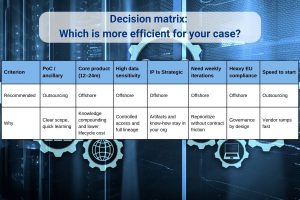
If three or more of your answers fall under the Offshore column, the long-term efficient choice is usually to build with a dedicated team. If most answers are in the Outsourcing column and you don’t expect continuous change, a scoped vendor project is likely more efficient right now. The direction of travel toward measurable outcomes is clear in the Deloitte Global Outsourcing Survey.
Implementation playbook (works for both models)
Team topology and overlap: Appoint a delivery lead who matches stakeholder language and culture; enforce 3–5 hours of daily overlap; run daily stand-ups and weekly demos.
Data and MLOps governance: Host repos, pipelines, and artifacts in your cloud tenant. Define data contracts, enforce environment segregation, maintain a model registry and feature store, and capture experiment metadata for reproducibility. Organizations with a clear AI roadmap and tooling posture are more likely to scale value beyond isolated pilots.
Quality baseline: Adopt one QA checklist across squads: unit/integration tests, golden datasets for evaluation, prompt and model version tracking, and an automated regression gate before shipping.
Operating cadence: Tie OKRs to business outcomes, monitor DORA metrics, and set explicit SLAs for incident response (MTTR) and change failure rate. Publish short ADRs for architectural choices to keep context durable as teams scale.
Commercials and legal: Contract for IP assignment, a clear exit plan, and a Data Processing Agreement (DPA) aligned with GDPR if you touch EU data; maintain an inventory of vendor licenses and managed services with upgrade/exit notes. For foundations on privacy obligations, start with this GDPR overview.
Verdict: Which is more efficient?
- Short-term (PoC, ancillary, demo-driven work): Software outsourcing is a more efficient, fast start, predictable scope, and clean economics.
- Long-term (core AI intelligent agent, sensitive data, weekly iteration): Offshore development is more efficient, faster learning loops, durable IP, and lower cost per reliable release over the product’s lifetime.
If you’re still on the fence, run a two-track evaluation: commission a tightly scoped PoC via outsourcing while you prototype your offshore rituals (overlap hours, QA baseline, data contracts) on a small feature. Measure learning-cycle time, release cadence, and rework cost for both tracks over a single quarter. The data will tell you which model is truly more efficient for artificial intelligence in business in your context. For deeper detail and region-specific tips, read our offshore development guide for Japan & Europe 2025 and explore how we structure dedicated teams at The IT Source.
Your Next Step: Build Your ODC with The IT Source
Your AI roadmap is complex, and the right development model is critical.
Contact The IT Source for an expert consultation to design an offshore AI team that aligns with your strategic goals