

AI Intelligent Agents: A Strategic Guide for Business in 2026
In today’s hyper-competitive global market, B2B companies across Europe and Japan face a dual challenge: the relentless pressure to innovate and the increasing complexity of the regulatory landscape. For leaders in finance, logistics, trade, and IT, the need for solutions that deliver not just efficiency but also unparalleled reliability and ironclad legal compliance has never been greater. While Artificial Intelligence (AI) is widely touted as the definitive answer, decision-makers are rightly cautious, seeking transparent and dependable pathways to implementation.
At The IT Source – a global partner for software development and AI services, we’ve designed this in-depth guide specifically for those leaders. We will move beyond the hype to provide a strategic framework for understanding the critical components of business AI. We will demystify the AI Intelligent Agent, explore the robust capabilities of the modern AI Platform, and delineate the crucial role of a specialized Artificial Intelligence Agency in navigating this powerful yet complex technological frontier. The focus is not just on what AI can do, but how it can be implemented responsibly and effectively to achieve tangible business outcomes.
Deconstructing the core component: What is an AI intelligent agent?
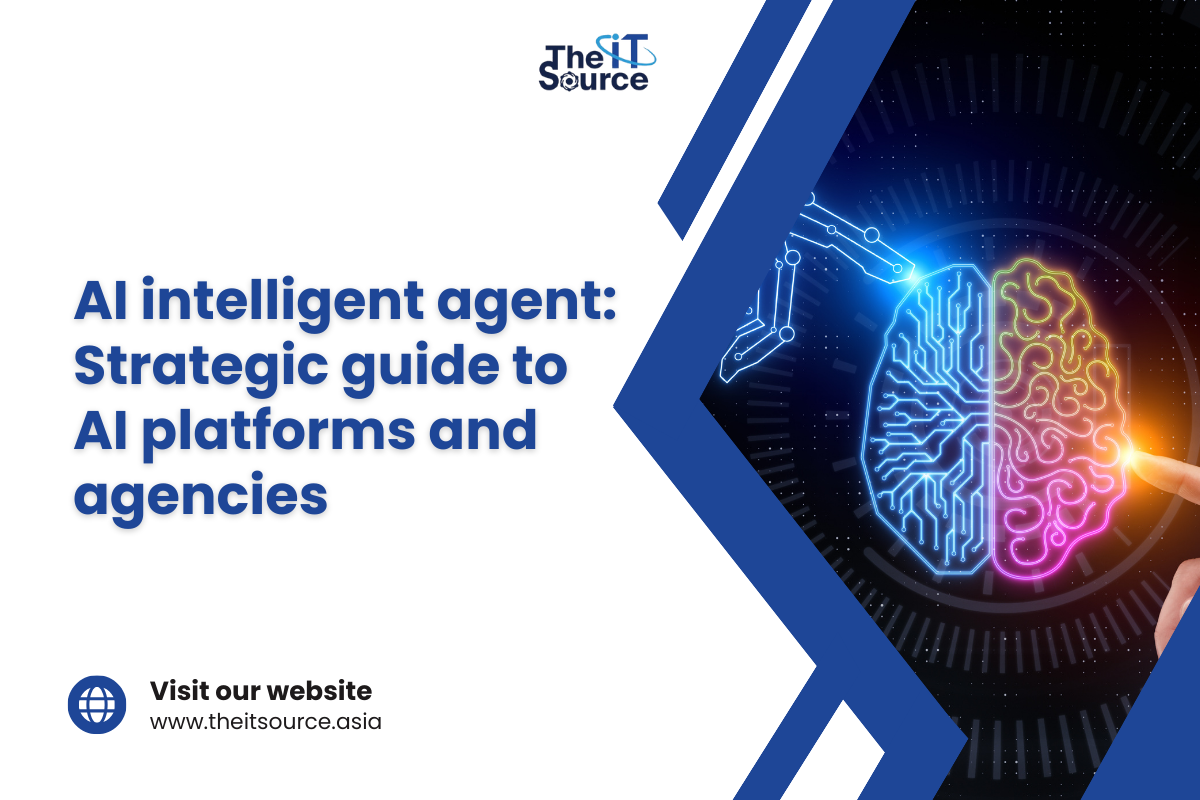
At its heart, an AI intelligent agent is an autonomous software entity engineered to perceive its operational environment, make decisions, and take actions to achieve specific, pre-defined goals. Think of it not as a simple script, but as a digital specialist assigned to a complex task. These agents operate on a cycle of “perceive-think-act,” constantly learning and adapting from the data they process.
Unlike basic automation tools that follow rigid “if-this-then-that” rules, intelligent agents leverage sophisticated algorithms to function with a degree of autonomy. They are the engine behind the applications transforming industries:
- In finance: An agent could be an advanced fraud detection system that analyzes transaction patterns in real-time, flagging anomalies far more accurately than a human team could.
- In logistics: An agent might be the core logic of a route optimization system, constantly recalculating the most efficient delivery paths based on live traffic, weather, and fleet availability data.
These agents are built upon the foundational principles of machine learning and deep learning, enabling them to recognize patterns, make predictions, and improve their performance over time without explicit reprogramming. They represent a fundamental shift from simply automating tasks to automating intelligence itself.
The business powerhouse: The strategic role of an AI platform
An AI intelligent agent cannot exist in a vacuum. It requires a robust, scalable, and secure environment for its entire lifecycle, from conception and training to deployment and ongoing management. This is the purpose of an AI platform.
A comprehensive AI Platform (like those offered by Google Cloud, AWS, or Azure) is an integrated suite of tools that provides the end-to-end infrastructure for AI development. Its key components include:
- Data ingestion and preparation: Tools to securely connect, clean, and label massive datasets are the lifeblood of any AI model.
- Model development and training: Frameworks and computational resources to build, experiment with, and train machine learning models at scale.
- MLOps (Machine Learning Operations): A critical set of practices for deploying, monitoring, and managing models in a production environment, ensuring they remain reliable, accurate, and secure over time. This is essential for the reliability valued by our target audience.
- Scalability and security: Cloud-native infrastructure that can scale resources on demand and provides business-grade security features to protect sensitive corporate and customer data.
For a decision-maker in the IT or finance sector, choosing the right platform is a strategic decision. A powerful AI platform ensures that your AI initiatives are not just one-off projects but scalable, manageable, and secure corporate assets that deliver continuous value.
Navigating the regulatory maze: AI, GDPR, and the EU AI Act
For any business operating in or doing business with Europe, legal compliance is a non-negotiable requirement. The introduction of AI adds new layers of complexity to regulations like the General Data Protection Regulation (GDPR) and the forthcoming EU AI Act. This is a critical risk factor that must be managed proactively.
- GDPR implications: This regulation governs the handling of personal data. When training AI models, companies must ensure the data used is compliant, anonymized where necessary, and that individuals’ rights (like the right to an explanation for an automated decision) are upheld.
- The EU AI Act: This landmark legislation introduces a risk-based framework for AI systems. Applications are categorized from minimal to unacceptable risk, with “high-risk” systems (common in finance, logistics, and critical infrastructure) facing stringent requirements for transparency, human oversight, and data governance. You can learn more about the specifics directly from the European Commission’s official source.
Navigating this legal maze is a monumental task. It requires a deep understanding of both the technology and the intricate legal requirements. A misstep can lead to severe financial penalties and reputational damage. This is where a specialized partner becomes indispensable.
The strategic decision: In-house AI team and partnering with an artificial intelligence agency
With a clear understanding of the components and the regulatory stakes, the crucial implementation question arises: should you build an in-house AI team or partner with an external agency?
1. The in-house approach:
Building an internal team provides maximum control and flexibility. However, decision-makers must soberly assess the Total Cost of Ownership (TCO) and inherent risks:
- Talent Scarcity: Data scientists, ML engineers, and AI compliance experts are rare and expensive to hire.
- High Upfront Investment: Significant costs for salaries, infrastructure, and specialized software.
- Extended Time-to-Value: It can take years to build a proficient team and see a return on investment.
- Risk of Siloed Knowledge: The team may lack the broad, cross-industry experience that drives true innovation.
2. Partnering with a specialist artificial intelligence agency:
For most businesses, this is the most efficient and reliable path to AI adoption. A strategic partnership with the right agency transforms a high-risk capital expenditure into a predictable, value-driven operational expense.
- Immediate access to expertise: You gain instant access to a vetted team of specialists who have solved similar problems for other clients in your industry.
- Accelerated time-to-value: Agencies leverage established frameworks, pre-built components, and deep platform knowledge to deliver solutions in months, not years.
- Compliance as a Service: A reputable artificial intelligence agency will have dedicated expertise in GDPR and the EU AI Act, embedding compliance into the development process from the outset.
- Transparency and risk mitigation: They provide clear project roadmaps, manage the technology risks, and ensure solutions are not “black boxes” but are explainable and transparent, a key value for your target audience. They are adept at utilizing established, business-ready solutions, such as the Google Cloud AI Platform, to ensure reliability and scalability.
Real-world use cases for finance, logistics, and trade
Let’s ground this in tangible applications for your key sectors:
- For finance and trade: An AI intelligent agent can be deployed for real-time supply chain risk assessment. By analyzing geopolitical data, weather patterns, and supplier performance, it can predict potential disruptions and recommend alternative sourcing strategies, ensuring business continuity. Another agent can automate the verification of trade finance documents (like letters of credit), reducing manual errors and processing time from days to minutes.
- For logistics: A sophisticated agent running on an AI platform can manage an entire warehouse. It can optimize inventory placement, direct autonomous forklifts, and forecast staffing needs based on incoming shipment data, dramatically increasing throughput and efficiency.
- For IT operations (AIOps): For IT decision-makers, intelligent agents can monitor complex cloud infrastructures, predict potential system failures before they occur, and automate remediation actions, ensuring maximum uptime and system reliability.
Your strategic path to an intelligent business
The adoption of Artificial Intelligence is no longer a question of “if,” but “how.” For discerning B2B leaders in Japan and Europe, the “how” must be strategic, compliant, and value-driven. The path forward lies in a clear-eyed understanding of the technology’s core components: AI intelligent agents as the functional workhorses, the AI platform as the essential industrial-grade factory, and the expert artificial intelligence agency as the indispensable strategic partner.
By choosing to partner with an agency, you are not simply outsourcing a technical project; you are acquiring a strategic capability. You are ensuring your AI initiatives are not only powerful and efficient but also reliable, transparent, and fully compliant with the complex regulatory standards of your market. This is the most secure and accelerated path to building a truly intelligent business.
Ready to explore how a tailored AI strategy can drive efficiency and ensure compliance for your business?
Schedule a complimentary strategic consultation with our experts to map out your AI implementation roadmap.